<?xml version="1.0" encoding="UTF-8"?>
<?xml-stylesheet type="text/xsl" href="/stylesheets/feed.atom.xml" media="screen"?>
<feed xml:lang="en-US" xmlns="http://www.w3.org/2005/Atom">
  <id>tag:pls.nd.edu,2005:/news-events/news</id>
  <link rel="alternate" type="text/html" href="https://pls.nd.edu"/>
  <link rel="self" type="application/atom+xml" href="https://pls.nd.edu/news-events/news.atom"/>
  <id>tag:pls.nd.edu,2005:/latest</id>
  <title>Program of Liberal Studies | News</title>
  <updated>2026-09-30T14:37:00-04:00</updated>
  <link rel="alternate" type="text/html" href="https://pls.nd.edu/"/>
  <link rel="self" type="application/atom+xml" href="https://pls.nd.edu//news-events/news.atom"/>
  <subtitle>Following an integrated curriculum composed of small discussion-based Seminars and Tutorials spanning the arts, history, literature, natural and social sciences, philosophy, politics, and theology, students and professors join a vibrant conversation about</subtitle>
  <entry>
    <id>tag:pls.nd.edu,2005:News/185903</id>
    <published>2026-09-30T14:37:00-04:00</published>
    <updated>2026-09-30T14:37:29-04:00</updated>
    <link rel="alternate" type="text/html" href="https://pls.nd.edu/news-events/news/office-hours-joseph-rosenberg-on-great-books-jazz-and-tea-cozies/"/>
    <title>Office Hours: Joseph Rosenberg on great books, jazz, and tea cozies</title>
    <summary type="text">
      <![CDATA[Program of Liberal Studies associate professor…]]>
    </summary>
    <content type="html">
      <![CDATA[<figure class="image image-default"><img src="https://al.nd.edu/assets/680487/1200x/20260617_jlh_pls_joseph_rosenberg_029_1200x.jpg" alt="Man with glasses in striped shirt and jeans smiles with arms crossed by bookshelves." width="600" height="450">
<figcaption>Program of Liberal Studies associate professor Joseph Rosenberg stands in front of his office space on the third floor of O'Shaughnessy Hall. (Photo by Jon L. Hendricks/University of Notre Dame)</figcaption>
</figure>
<p>The Program of Liberal Studies is known as the University of Notre Dame’s great books major. And <a href="https://pls.nd.edu/people/joseph-rosenberg/">Joseph Rosenberg</a> has never taken the time to count just how many books line the wall of his O’Shaughnessy Hall office.</p>
<p>“I think the answer is between just enough and too much,” he said. “There’s a saying, ‘How many books do you need? Just one more.’”</p>
<p>This feature is part of a College of Arts &amp; Letters story series called “Office Hours,” which provides a glimpse into the personal and professional lives of Arts &amp; Letters faculty through their workspaces around campus. This installment highlights Rosenberg, an associate professor in the <a href="https://pls.nd.edu/">Program of Liberal Studies (PLS)</a> and a literary critic interested in researching and pushing the boundaries of literature.</p>
<p>In this interview, Rosenberg discusses important mementos in his office that inspire him, are relevant to his work, and remind him of the relationships he’s developed with students.</p>
<p>Rosenberg’s answers have been edited for clarity and conciseness.</p>
<figure class="image image-default"><img src="https://al.nd.edu/assets/680554/1200x/20260617_jlh_pls_joseph_rosenberg_002_1200x2.jpg" alt='Two books by J.H. Prynne are laid on a table, one titled "Kazoo Dreamboats."' width="600" height="450">
<figcaption>PLS associate professor Joseph Rosenberg collects contemporary poetry pieces that open up into a secret world. (Photo by Jon L. Hendricks/University of Notre Dame)</figcaption>
</figure>
<h2><strong>Q: Your office wall is full of so many books, ranging in size and color. Where do you go to find the next great book?</strong></h2>
<p>A: I try to get them from independent bookstores, but it’s so hard these days. While I try to get them secondhand, I’m very interested in contemporary poetry, which can be a lot harder to find because it’s mostly put out by very tiny presses. Some of these are quite boutique and letterpress, but some are even produced on someone’s photocopier.</p>
<p>I find these mostly through word of mouth or through reviews in journals or even blogs. But even then, I’ll often discover that a poet I’m interested in produced a volume three years ago that I never ever heard of. I like keeping a few pamphlets out for students to see. The titles alone – like “Kazoo Dreamboats,” say, or “Wild Ascending Lisp” – seem like tickets to a secret world.</p>
<h2><strong>Q: What are some pieces that continuously inspire you? </strong></h2>
<figure class="image image-left"><img src="https://al.nd.edu/assets/680465/600x/20260617_jlh_pls_joseph_rosenberg_024_1200x.jpg" alt="Man wearing a striped shirt plays a black electric guitar in front of a bookshelf." width="600" height="400">
<figcaption>An amateur jazz player, PLS associate professor Joseph Rosenberg will play some chords whenever he needs a break from writing. (Photo by Jon L. Hendricks/University of Notre Dame)</figcaption>
</figure>
<p>A: I keep a picture on my desk that belonged to my dad, by the artist Stan Washburn. It’s from his “Moral Alphabet of Vice and Folly.” It depicts a philosopher holding a skull, seemingly in deep contemplation. The caption reads, “A philosopher concluded that man’s pretensions are absurd, and that worldly endeavor is without purpose. So assiduous were his ruminations on this insight that he neglected to publish, and in due course, he perished. Moral: publish.”</p>
<p>I keep it on my desk as a reminder to keep writing, but also to not take it so seriously.</p>
<p>I also have a poster of Henry James in tribute to my mother, who is also a literary scholar and has spent her career working on James.</p>
<p>My earliest work was on James, but I’m now more focused on later literary developments. In my scholarship, I’m interested in extremes of language and representation. Some of the books I work on push language as far as one can with it still being — or at least vaguely resembling — literature.</p>
<p>I also keep a guitar in my office. I’m an amateur jazz musician — a passion I shared with my dad — and I play to decompress. But music can also act as a writing tool. If I’m stuck on a really thorny paragraph and need to think it through, it can be nice to pick a guitar up and do something that uses an entirely different part of my brain, and then get back to my work refreshed.</p>
<h2><strong>Q: Having previously served as the PLS director of undergraduate studies (DUS), how would you explain the program to someone who doesn’t know anything about it? </strong></h2>
<p>A: I think the program, once students hear about it, more or less sells itself.</p>
<p>But when students initially just see those initials, “PLS,” they wonder, “Is it poli sci? Is it philosophy?” Well, yes, it is, but also so much more.</p>
<p>The hardest part of being DUS, but also the most pleasurable, was simply explaining to students what it is that we do. In PLS, we study works spanning from ancient Greece to this century, and across a variety of disciplines – literature, philosophy, theology, science, and music. Our classes are small and discussion-based, and the sheer wealth of material students read allows them to see and understand the world from the widest range of perspectives. And seeing the similar range of students we get in the program has been a great pleasure.</p>
<p>There’s something in PLS for everyone, but I think our greatest strength is that we have students read works that they might not otherwise encounter, indeed that they might initially think might not interest them, whether that’s a work of ancient philosophy or contemporary poetry. PLS asks students to be curious about everything.</p>
<p>When I was DUS, I would often tell interested students, “Well, you know that Arts &amp; Letters slogan, ‘Study everything. Do anything.’? We’re the department that actually does that.”</p>
<figure class="image image-right" style="padding: 0; width: 450px; margin-left: 1em;"><img src="https://al.nd.edu/assets/680468/20260617_jlh_pls_joseph_rosenberg_009_600x.jpg" alt="Collage with Dalis urinal, pipe, books, and a game box connected by red string and pins." width="450" height="300"> <img src="https://al.nd.edu/assets/680460/20260617_jlh_pls_joseph_rosenberg_007_600x.jpg" alt="Teapot with knitted cozy featuring a goose and French text." width="450" height="300"> <img src="https://al.nd.edu/assets/680458/20260617_jlh_pls_joseph_rosenberg_010_600x.jpg" alt="Framed blue portrait of a man with dark hair and intense eyes sits next to books." width="450" height="300">
<figcaption style="display: block;">Rosenberg challenges students to be creative and they've made pieces such as a modernism conspiracy board (top), a tea cozy (middle), and a Picasso-blue-period-esque portrait of author Samuel Beckett (below). (Photos by Jon L. Hendricks/University of Notre Dame)</figcaption>
</figure>
<h2><strong>Q: What are some tokens you have from your students? </strong></h2>
<p>A: One of my students made this amazing modernism conspiracy board, which takes various avant-garde art movements — surrealism, dadaism, vorticism — and tries to connect them. But the attempt to make sense of them all ends up just looking like a paranoid delusion.</p>
<p>Another piece, also a student’s final project from a class I teach on modernism, is this deceptively chintzy tea cozy. It has a swan on it in tribute to the French poet Charles Baudelaire. It reads in French, “I’m catching the taxi to death.” The student’s explanation was that he wanted the tea cozy to be an example of how even the most transgressive art will eventually be transformed into consumer culture.</p>
<p>A year or two ago, I offered a directed reading on the works of Samuel Beckett, and my student painted this very Picasso-blue-period-esque portrait of Beckett. While I, of course, still ask students to write essays, I want to give them an opportunity to do something more creative.</p>
<h2>
<strong>Q: Your first book, </strong><strong><em>Wastepaper Modernism: Twentieth-Century Fiction and the Ruins of Print</em></strong><strong> (Oxford University Press, 2021), examines how famous modernist writers responded to new media, which at that time was cinema. How do you apply that to today’s world with the evolution of artificial intelligence and its influence on writing?</strong>
</h2>
<p>A: Looking back 120 years ago, when things like the cinema and the radio were the new kids on the block, writers got extremely anxious. But, as I argue in <em>Wastepaper Modernism</em>, out of this anxiety came a new kind of literature. So with AI, it’s tricky, right? Because part of me wants to say, “Well, we’ve been through this before, and literature has been just fine.” But at the same time, AI — and large language models, in particular — work in literature’s own medium of language, which perhaps makes it more of a threat to writing.</p>
<p>I take heart, though, that one of the things that AI can’t do well, yet, is write poetry. The literature that it produces tends to be very predictable, moralistic, and just really, really dull. The sorts of things that I value in literature — formal experimentation, newness, novelty — are the very things that AI can’t do. AI draws on and reproduces everything that’s already been done, but it cannot, as of yet, produce anything truly different or original.</p>
<p>Anecdotally, I’ve noticed my students gravitating more towards older media. Some of my students even want to handwrite their papers. Maybe they think of handwriting as the ultimate proof that they didn’t use AI to write their paper, or maybe they just want to make something with their hands. In any case, I think it shows that the matter of writing still matters.</p>
<h2><strong>Q: What do you hope people feel when they come into your office?</strong></h2>
<figure class="image image-left"><img src="https://al.nd.edu/assets/680492/600x/20260617_jlh_pls_joseph_rosenberg_005_1200x.jpg" alt="Man in striped shirt laughs with hand on chest, Notre Dame London poster visible." width="600" height="450">
<figcaption>Rosenberg wants students, and himself, to feel at ease in his office. (Photo by Jon L. Hendricks/University of Notre Dame)</figcaption>
</figure>
<p>A: I want it to feel welcoming. With all the books, it would seem to have a weight of seriousness that I hope is somewhat lightened by tea cozies and modernism conspiracy boards.</p>
<p>I want an office space that puts students at ease, and that puts me at ease as well. Sometimes my classes can be back-to-back. But even with 10-15 minutes in between, I can come in here, close the door, take a breath, have a coffee, and then go back to the classroom refreshed.</p>
<p>The espresso machine is probably the one thing students will never get to use. I did once have a student very cheekily ask during office hours, “Hey, can you make me a coffee?” My answer was, “There’s a Starbucks over in LaFortune.” Hospitality has to have its limits!</p>
<p class="attribution">Originally published by <span class="rel-author">Mary Kinney</span> at <span class="rel-source"><a href="https://al.nd.edu/news/latest-news/office-hours-joseph-rosenberg-on-great-books-jazz-and-tea-cozies/">al.nd.edu</a></span> on <span class="rel-pubdate">September 30, 2026</span>.</p>]]>
    </content>
    <link rel="enclosure" type="image/jpeg" href="https://pls.nd.edu/assets/680775/20260617_jlh_pls_joseph_rosenberg_029_1200x.jpg" title="Man with glasses in striped shirt and jeans smiles with arms crossed by bookshelves."/>
    <author>
      <name>Mary Kinney</name>
    </author>
  </entry>
  <entry>
    <id>tag:pls.nd.edu,2005:News/185015</id>
    <published>2026-08-24T12:14:00-04:00</published>
    <updated>2026-08-24T12:15:08-04:00</updated>
    <link rel="alternate" type="text/html" href="https://pls.nd.edu/news-events/news/a-scholars-journey-international-student-lipe-fernandes-cultivates-an-intellectual-life-through-pls/"/>
    <title>A scholar’s journey: International student Lipe Fernandes cultivates an intellectual life through PLS</title>
    <summary type="text">
      <![CDATA[Lipe Fernandes…]]>
    </summary>
    <content type="html">
      <![CDATA[<figure class="image image-right"><img src="https://al.nd.edu/assets/674294/fullsize/img_9109.jpg" alt="A young man with short dark curly hair smiling and looking at the camera with his arms folded, wearing a white collared button up shirt." width="300" height="400">
<figcaption>Lipe Fernandes</figcaption>
</figure>
<p>When Lipe Fernandes considered his education after high school, he wanted something more than career prep.</p>
<p>He wanted the whole college experience — something that would develop him as a person, not just his resume.</p>
<p>“Education shouldn’t be only a utilitarian thing,” he said. “In college, you have the opportunity to explore more than just what you think you’ll be doing in the future.”</p>
<p>Fernandes’ appetite for something more drove him to leave his home country of Brazil to study in the U.S., and it’s why he’s glad he picked the University of Notre Dame.</p>
<p>“I found something where I can cultivate both an intellectual life and a practical life,” he said.</p>
<p>As an incoming student, he initially majored in <a href="https://economics.nd.edu/">economics</a> and <a href="https://philosophy.nd.edu/">philosophy</a> to better understand the forces shaping current social issues. But as he learned more about what he wanted from his undergraduate education, he swapped economics for <a href="https://politicalscience.nd.edu/">political science</a> — a field more qualitative and flexible. But there was still something missing.</p>
<p>“At Notre Dame, we have to take philosophy classes, theology classes, literature, languages,” he said. “And I realized I wanted something that didn’t treat them separately, but tried to unify them.”</p>
<p>In his second semester, Fernandes took a University Seminar class — Catholicism &amp; the Disciplines: The Catholic Intellectual Life — with <a href="https://pls.nd.edu/people/thomas-a-stapleford/">Thomas Stapleford</a>, an associate professor in the <a href="https://pls.nd.edu/">Program of Liberal Studies</a>. Stapleford saw how much Fernandes enjoyed the class’ interdisciplinary approach and encouraged him to consider PLS.</p>
<p>Interdisciplinary by nature, the PLS major gives students exposure to the arts, history, literature, natural science, philosophy, politics, and theology through six “great books” seminars. Students also take tutorials that delve into specific disciplines of the liberal arts.</p>
<figure class="image image-left"><img src="https://al.nd.edu/assets/674296/fullsize/20260123_010102_96086c.jpg" alt="A man in white robes under a black puffer jacket points to somewhere out of the frame, guiding the sights of a group of college students in cold weather clothing. The Colosseum is in the background." width="600" height="400">
<figcaption>Lipe Fernandes (fourth from the left) and his study abroad group learn about the sites of Rome, including the Colosseum. (Photo provided by Lipe Fernandes)</figcaption>
</figure>
<p>It was just what Fernandes was looking for.</p>
<p>“PLS isn’t just the academic part of philosophy — it’s giving me the tools to think about anything in a philosophical way,” he said.</p>
<p>Now majoring in PLS and political science, Fernandes spends his days exploring justice and equality through Dante’s <em>Divine Comedy</em> or freedom and humanity through St. Augustine’s <em>Confessions</em>. In conversations with his classmates, he encounters a broad range of perspectives on topics from current events to what it means to be human.</p>
<p>Through PLS, Fernandes has also reframed his political science classes, saying it simply brings similar ideas into the present by thinking about philosophy, history, psychology, and other liberal arts in the context of American politics and international relations.</p>
<p>In spring 2026, the now-senior further pursued his love of philosophy and PLS while studying abroad in Rome. He completed a philosophy and theology program at the Thomistic Institute, an organization that strengthens the Catholic intellectual tradition rooted in the thought of St. Thomas Aquinas. He also took classes on metaphysics and the history of intellectual culture, as well as Italian and medieval art.</p>
<p>During his time in Rome, he was happy to learn that his dorm was only a few blocks from Notre Dame Rome, with the Colosseum and the Archbasilica of St. John Lateran also nearby. It was a piece of home away from home, he said, as his love for Notre Dame’s campus and community grew alongside his intellectual formation over the last three years.</p>
<figure class="image image-right"><img src="https://al.nd.edu/assets/674295/fullsize/d092f98a_7d6d_4782_8fc8_e9399ba28783.jpg" alt="A group of young men in a group photo at a stadium, most of them wearing cold-weather clothing including Notre Dame-branded hats." width="600" height="400">
<figcaption>Lipe Fernandes (left) with his friends at the Notre Dame football game against Indiana University in 2024. (Photo provided by Lipe Fernandes)</figcaption>
</figure>
<p>“Notre Dame has this notion of a university as a little world where you live,” he said. “It’s not just the place you go to school.”</p>
<p>Back in Indiana, Fernandes loves participating in quintessential student experiences — attending football games, joining campus snowball fights, walking around the lakes, and Grotto visits with fellow residents of Keough Hall (followed by either milkshakes or root beer floats in the dorm kitchen). He’s grown in his faith by studying theology, by talking with Keough’s priest-in-residence, and by sharing his beliefs with his friends. Every day, he’s trying new things and meeting new people, his character and his intellect developing in tandem.</p>
<p>That’s what college should be, Fernandes said, and it’s why he’s taking the extra step to make PLS more accessible for others.</p>
<p>This summer, Fernandes brought a bit of what he learned back to São Paulo, where a local priest has started a classical school for young kids. He has helped run the school and create curriculum that taps into his experiences as a student in the College of Arts &amp; Letters.</p>
<p>“If you study things that are good for you as a human person, you can not only become better and happier for yourself, but you can also learn to become a citizen,” Fernandes said. “You know how to perform your duties and be good to each other as brothers and sisters — in your house, your city, your church, your country.”</p>
<p class="attribution">Originally published by <span class="rel-author">Adah McMillan</span> at <span class="rel-source"><a href="https://al.nd.edu/news/latest-news/a-scholars-journey-international-student-lipe-fernandes-cultivates-an-intellectual-life-through-pls/">al.nd.edu</a></span> on <span class="rel-pubdate">August 21, 2026</span>.</p>]]>
    </content>
    <link rel="enclosure" type="image/jpeg" href="https://pls.nd.edu/assets/674967/img_9109big.jpg" title="A young man with short dark curly hair smiling and looking at the camera with his arms folded, wearing a white collared button up shirt. He's in a large room with three large windows and two columns in the background."/>
    <author>
      <name>Adah McMillan</name>
    </author>
  </entry>
  <entry>
    <id>tag:pls.nd.edu,2005:News/185018</id>
    <published>2026-08-20T12:39:00-04:00</published>
    <updated>2026-08-24T12:39:51-04:00</updated>
    <link rel="alternate" type="text/html" href="https://pls.nd.edu/news-events/news/for-good-why-notre-dame-still-believes-in-the-liberal-arts-with-dean-kenneth-scheve/"/>
    <title>For Good: Why Notre Dame still believes in the liberal arts, with Dean Kenneth Scheve</title>
    <summary type="text">
      <![CDATA[In an age of artificial intelligence, rapid change, and global uncertainty, Kenneth Scheve ’90, the I.A. O’Shaughnessy Dean of the College of Arts &amp; Letters and Keough -Hesburgh Professor of Political Science, believes the liberal arts…]]>
    </summary>
    <content type="html">
      <![CDATA[<p>In an age of artificial intelligence, rapid change, and global uncertainty, <a href="https://al.nd.edu/about/people/kenneth-scheve/">Kenneth Scheve </a>’90, the I.A. O’Shaughnessy Dean of the College of Arts &amp; Letters and Keough -Hesburgh Professor of Political Science, believes the liberal arts are not becoming less relevant — they are becoming more essential. </p>
<p>At Notre Dame, he’s building on the University’s tradition of educating both the heart and the mind while preparing students to think deeply, engage new ideas, and lead with purpose.</p>
<p>Join us for this episode of <a href="https://givemonthly.nd.edu/">For Good</a> as Dean Scheve reflects on the enduring role of Arts &amp; Letters at Notre Dame, the College’s growing commitment to global education and research that serves the common good, and why a liberal arts education remains one of the best foundations for leadership and service in a changing world.</p>
<p><iframe width="1200" height="673" src="https://www.youtube.com/embed/2MYTjwoME9M" allowfullscreen="allowfullscreen"></iframe></p>
<p class="attribution">Originally published by <span class="rel-author">ND Loyal</span> at <span class="rel-source"><a href="https://al.nd.edu/news/latest-news/for-good-why-notre-dame-still-believes-in-the-liberal-arts-with-dean-kenneth-scheve/">al.nd.edu</a></span> on <span class="rel-pubdate">August 07, 2026</span>.</p>]]>
    </content>
    <link rel="enclosure" type="image/jpeg" href="https://pls.nd.edu/assets/674970/20250723_jlh_dean_kenneth_scheve_001.jpg" title="A smiling gray-haired man in glasses, a dark suit, light blue shirt, and blue and gold striped tie stands with arms crossed before vibrant stained glass windows."/>
    <author>
      <name>ND Loyal</name>
    </author>
  </entry>
  <entry>
    <id>tag:pls.nd.edu,2005:News/185017</id>
    <published>2026-08-17T12:36:00-04:00</published>
    <updated>2026-08-24T12:37:28-04:00</updated>
    <link rel="alternate" type="text/html" href="https://pls.nd.edu/news-events/news/how-the-great-books-prepared-program-of-liberal-studies-major-quinn-mckenna-23-for-her-postgrad-chapters/"/>
    <title>How the ‘great books’ prepared Program of Liberal Studies major Quinn McKenna ’23 for her postgrad chapters</title>
    <summary type="text">
      <![CDATA[Program…]]>
    </summary>
    <content type="html">
      <![CDATA[<figure class="image image-default"><img src="https://al.nd.edu/assets/659820/1200x/q_mckenna_headshot_1200x.jpg" alt="A smiling woman with long, wavy, reddish-brown hair, wearing a black top, stands in a vibrant green field." width="1200" height="960"></figure>
<p><a href="https://pls.nd.edu/">Program of Liberal Studies</a> major Quinn McKenna ’23 knows that even the “great books” are built one line, one chapter at a time.</p>
<p>The best career advice she got from her professors was to do exactly that: focus on just the next chapter.</p>
<p>“If you let your interests and your passion guide this next chapter, everything will unfold as it should,” she said.</p>
<p>Since graduating, the south Florida native has worked at a South Bend non-profit, taught in Panama on a Fulbright scholarship, and worked in marketing consulting for purpose-driven clients that include Notre Dame.</p>
<p>Her liberal arts education empowered her with the writing and critical thinking skills to thrive across all of these unique chapters.</p>
<p>“The liberal arts open doors and possibilities,” she said. “And prepare you well for whichever path you decide to take.”</p>
<h2>A time of growth</h2>
<p>As a self-proclaimed “book nerd,” McKenna was immediately drawn to the Program of Liberal Studies’ promise of the opportunity to analyze foundational texts in small, intimate class settings.</p>
<p>“The primary thing I wanted out of my education was growth, immersion, and excitement,” she said. “I wanted to go to class excited about what I was going to learn.”</p>
<p>In the major and in the <a href="https://al.nd.edu/">College of Arts &amp; Letters</a> as a whole, she found a community of students with this same desire.</p>
<figure class="image image-left"><img src="https://al.nd.edu/assets/659816/img_7733_2_600x.jpg" alt="Four smiling young women, two in green, with one wearing face paint, pose closely in a crowd at Notre Dame Stadium." width="600" height="480"></figure>
<p>“Arts &amp; Letters students have this insatiable curiosity about the world that is not easily quenched,” she said.</p>
<p>McKenna and her classmates — representing a wide range of interests, backgrounds, and beliefs — were all discerning their career paths. Going through this process brought them closer together and even provided a means of clarity.</p>
<p>“I have friends who are Montessori school teachers. I have friends who are in venture capital, in finance. One joined the priesthood,” McKenna said. “That gave us all a really good opportunity to bounce ideas off of each other and figure out for ourselves what we felt called to do.”</p>
<p>McKenna’s first chapter after graduation was with the nonprofit Downtown South Bend — a natural extension of her role as director of South Bend engagement in student government. She helped plan community engagement events like First Fridays, creating opportunities for local businesses and community members to connect and thrive.</p>
<p>Then McKenna followed her passions to something — and somewhere — new.</p>
<p>“I made a promise to myself that I would try to do a postgrad program or other form of extended international experience because I wanted to open my mind to the global sphere and experience true cross-cultural immersion,” she said.</p>
<p>With support from the <a href="https://cuse.nd.edu/">Flatley Center for Undergraduate Scholarly Engagement</a>, McKenna applied for and was awarded a Fulbright scholarship to teach English in Chiriqui, Panama.</p>
<p>This chapter allowed McKenna to further explore her interest in teaching. While at Notre Dame, she worked with TutorND, volunteered with the Take 10 Violence Prevention Program in South Bend schools, and worked at the <a href="https://ecdc.nd.edu/">Early Childhood Development Center</a> on campus. She was also an <a href="https://iei.nd.edu/ess">Education, Schooling, and Society</a> minor.</p>
<p>McKenna had also taught English to sixth-grade students in Panama through the <a href="https://socialconcerns.nd.edu/">Institute for Social Concerns</a>, though it was on Zoom due to the pandemic.</p>
<figure class="image image-right"><img src="https://al.nd.edu/assets/659818/img_1489_600x.jpg" alt="Smiling adults and students pose playfully in a classroom with &quot;The Lord's Prayer&quot; on the whiteboard." width="600" height="480"></figure>
<p>This in-person Fulbright experience offered a new form of personal and professional growth. McKenna taught English classes across multiple levels, even designing curriculum and teaching a university-level English literature course.</p>
<p>“Teaching and speaking a different language is another incredible way to improve communication and critical thinking skills,” she said.</p>
<p>Everything from renting a car in Spanish, to standing in front of a classroom, to presenting in an auditorium of hundreds of TESOL teachers, made her a stronger, more independent thinker — and even helped prepare her for her next chapter in the private sector.</p>
<h2>Bringing curiosity to consulting</h2>
<p>As her Fulbright ended, McKenna wanted to lean further into the communication skills she gained teaching abroad.</p>
<p>“It's all about knowing your audience and gearing what you're saying to resonate with that audience,” she said. “By teaching and speaking in another language, you learn how to break the same idea into different pieces based on your audience, finding ways to change wording but still articulate the same meaning.”</p>
<p>This directly influenced her decision to pursue a career in marketing consulting.</p>
<p>McKenna was drawn to firm Global Prairie’s mission-driven clients, including university health systems, nonprofits, and even college athletics departments.</p>
<p>Global Prairie’s founder — Anne St. Peter, the parent of a Notre Dame graduate — recognized the value liberal arts majors bring to business.</p>
<p>“She believes liberal arts students bring a curiosity and quickness that are incredibly valuable,” McKenna said.</p>
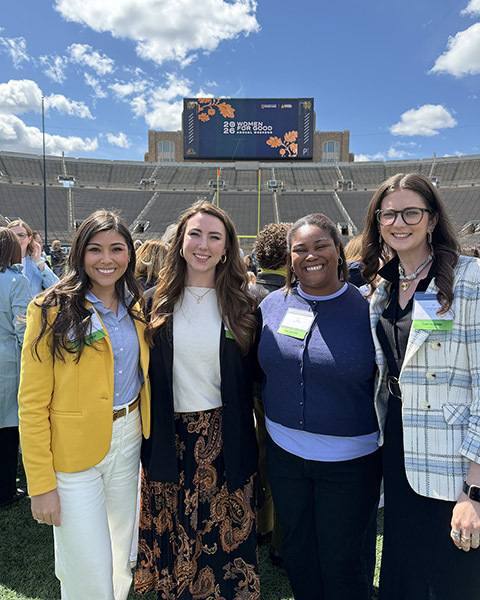
<figure class="image image-left"><img src="https://al.nd.edu/assets/659821/img_3664_600x.jpg" alt="Four smiling women on Notre Dame Stadium field. Scoreboard shows '20 WOMEN 26 FOR GOOD' beneath a blue sky." width="480" height="600"></figure>
<p>Today, McKenna enjoys helping brands figure out who they are — a question that is familiar to the Program of Liberal Studies.</p>
<p>One of her current clients is <a href="https://hwoi.nd.edu/">Hesburgh Women of Impact</a>. McKenna and her colleagues worked with program director Kari Tarman and Sara Liebscher, associate vice president of development, on a refreshed brand identity. They used it to develop their new website and the design themes and materials for the Women for Good Annual Weekend, and HWOI’s marquee event.</p>
<p>“I will always be grateful for my liberal arts education,” McKenna said. “I’ve not had a single regret in terms of what I studied and what direction I ended up taking.”</p>
<p>McKenna’s favorite text from the Program of Liberal Studies is <em>The Way Things Are </em>by<em> </em>the ancient Roman philosopher and poet Lucretius. In it, Lucretius describes life not as something with an end to fear, but as a great feast for one to enjoy and leave satisfied and grateful.</p>
<p>“That is the approach to life I want to take,” McKenna said. “I want to be present, be grateful for where I am, and let that gratitude satiate me.”</p>
<p class="attribution">Originally published by <span class="rel-author">Hailey Oppenlander</span> at <span class="rel-source"><a href="https://al.nd.edu/news/latest-news/how-the-great-books-prepared-program-of-liberal-studies-major-quinn-mckenna-23-for-her-postgrad-chapters/">al.nd.edu</a></span> on <span class="rel-pubdate">May 15, 2026</span>.</p>]]>
    </content>
    <link rel="enclosure" type="image/jpeg" href="https://pls.nd.edu/assets/674969/img_6665_2_1200x.jpg" title="A smiling woman in cap and gown holds her Notre Dame Bachelor of Arts diploma near the Ara Parseghian Gate."/>
    <author>
      <name>Hailey Oppenlander</name>
    </author>
  </entry>
  <entry>
    <id>tag:pls.nd.edu,2005:News/178740</id>
    <published>2026-01-28T08:47:00-05:00</published>
    <updated>2026-01-28T08:47:44-05:00</updated>
    <link rel="alternate" type="text/html" href="https://pls.nd.edu/news-events/news/a-cross-pollination-of-ideas-interdisciplinary-research-collaborative-brings-virtue-ethics-into-ai/"/>
    <title>A ‘cross-pollination of ideas’: Interdisciplinary research collaborative brings virtue ethics into AI</title>
    <summary type="text">
      <![CDATA[…]]>
    </summary>
    <content type="html">
      <![CDATA[<figure class="image image-default"><img src="https://al.nd.edu/assets/644934/fullsize/20250416_jlh_franco_institute_tom_stapleford_and_patrick_gamez_014.jpg" alt="Two men smile and collaborate at a light wood table, surrounded by books and a laptop. One man, in a dark shirt and glasses, works on the computer. The other, with a gray beard, wears a blue sweater and glasses, holding a book. A bright green wall is in the background." width="1200" height="800">
<figcaption>Patrick Gamez (left) and Tom Stapleford discuss their ideas in the Franco Family Institute for Liberal Arts and the Public Good. (Photo by Jon L. Hendricks/University of Notre Dame)</figcaption>
</figure>
<p>Imagine talking to your favorite stuffed animal — something you confide in at 7 years old because you know that an inanimate object won't share your secrets, invalidate your feelings, or question your motives.</p>
<p>But what if it starts talking back? For today's and tomorrow's children, that's likely to become a common reality.</p>
<p>A <a href="https://heycurio.com/">Silicon Valley startup</a> has created a stuffed animal with a Wi-Fi-enabled voice box, linked to a chatbot powered by generative artificial intelligence. The company promises lively companions that can elevate children’s play with stimulating conversation, and in order to prevent parental concerns about the content of chats, it’s designed its toys to stay cheery and avoid inappropriate topics.</p>
<p><a href="https://pls.nd.edu/people/thomas-a-stapleford/">Tom Stapleford</a> isn’t so sure that forethought goes far enough.</p>
<blockquote class="pull">
<p>“Bringing folks together from different parts of the University, you make connections you had no idea about because you didn’t even know that this research existed, much less that there was somebody at Notre Dame working on this area." - Tom Stapleford, associate professor in the Program of Liberal Studies</p>
</blockquote>
<p>“None of that addresses the question, ‘Is it really good for children to be engaging with a chatbot?’” said Stapleford, an associate professor in the <a href="https://pls.nd.edu/">Program of Liberal Studies</a> and scholar of the history of science and virtue ethics at the University of Notre Dame.</p>
<p>Stapleford and colleague <a href="https://reilly.nd.edu/people/patrick-gamez/">Patrick Gamez</a> argue that if AI will actually help humanity, there’s a need for more than just regulations — there’s also a need to consider how AI can enable and facilitate human well-being.</p>
<p>To accomplish that goal, the duo created the <a href="https://franco.nd.edu/research/research-innovation-collaboratives/generative-ai-research-innovation-collaborative/">Generative AI Research Innovation Collaborative</a>, one of the <a href="https://franco.nd.edu/">Franco Family Institute for Liberal Arts and the Public Good</a>’s inaugural set of interdisciplinary research groups. The collaborative gathered scholars from across campus who are interested in generative AI and its intersections with the humanities.</p>
<p>“What we wanted to do was convene a network of researchers and provide a space for them to pursue interdisciplinary research,” said Gamez, an associate teaching professor in the <a href="https://reilly.nd.edu/">Reilly Center for Science, Technology, and Values</a> and director of its five-year dual degree program in the College of Arts &amp; Letters and College of Engineering. “It’s through the cross-pollination of ideas with a bunch of people from different backgrounds that these projects grow.”</p>
<p>Before the collaborative, Stapleford and Gamez knew of other Notre Dame researchers working to answer generative AI questions, but the lab’s workshops brought everyone together to share ideas and research, as well as their questions and doubts about the largely uncharted field.</p>
<p>Those conversations included <a href="https://kroc.nd.edu/faculty-and-staff/lisa-schirch/">Lisa Schirch</a>, the Richard G. Starmann Sr. Professor of the Practice of Peace Studies in the <a href="https://keough.nd.edu/">Keough School of Global Affairs</a>, who is using AI systems to facilitate democratic discussions. <a href="https://altech.nd.edu/people/alexi-orchard/">Alexi Orchard</a>, an assistant teaching professor in Arts &amp; Letters’ <a href="https://altech.nd.edu/">Technology and Digital Studies Program</a>, is gathering data on interactions between generative AI and her students — one of the groups most impacted by the rise of AI. In an August workshop, Gamez presented his research on the intertwined histories of AI and counterintelligence, and Stapleford discussed AI and labor.</p>
<p>“Bringing folks together from different parts of the University, you make connections you had no idea about because you didn’t even know that this research existed, much less that there was somebody at Notre Dame working on this area,” Stapleford said. “It just sends out sparks in all kinds of different directions.”</p>
<h2 dir="ltr">Analyzing AI’s potential for good</h2>
<p>The collaborative began as a reading group led by <a href="https://pls.nd.edu/people/robert-goulding/">Robert Goulding</a>, an associate professor in the Program of Liberal Studies and director of the Reilly Center. The group discussed the work of German philosopher Martin Heidegger in relation to AI and language — which seemed important as large language models like ChatGPT began to produce more humanlike speech, Gamez said.</p>
<p>To him and Stapleford, the reading group proved the value of philosophical, interdisciplinary conversations around AI, and they wanted to keep talking.</p>
<figure class="image image-left"><img src="https://al.nd.edu/assets/645030/fullsize/20250416_jlh_franco_institute_tom_stapleford_and_patrick_gamez_021.jpg" alt="Two men discuss in a lime green meeting room. One man, in a dark shirt, gestures while speaking to another in a blue sweater, arms crossed. A large screen displays an article &quot;AI means the end of Internet search as we've known it.&quot;" width="600" height="400">
<figcaption>Patrick Gamez (left) and Tom Stapleford talk the future of internet search in the Franco Family Institute for Liberal Arts and the Public Good. (Photo by Jon L. Hendricks/University of Notre Dame)</figcaption>
</figure>
<p>Along with Goulding, the researchers began working on an application for a National Endowment for the Humanities grant to continue researching AI and the humanities at Notre Dame. And when they received Franco Institute funding to start their research collaborative, they saw an opportunity to further develop the ideas in their grant proposal and bring more scholars into the effort.</p>
<p>“At each workshop, all sorts of themes come up,” Gamez said. “We heard talks about empathy and spirituality and freedom — all sorts of dimensions of our interaction with AI agents.”</p>
<p>Discussions fostered through the collaborative brought the idea of AI’s agency to the forefront. Agency is a complicated concept to conclusively characterize, and its definition and application can vary from scholar to scholar. For example, an engineer might say ChatGPT is an agent because it behaves intelligently, but a philosopher may disagree, arguing that a being needs consciousness to be an agent, Gamez said.</p>
<p>Balancing these perspectives, the Collaborative found value in using the agency of AI as a lens for their analysis.</p>
<p>“AI systems respond to their environment in a dynamic way, and even though they’re not consciously striving after goals, they have certain functions that they’re trying to maximize,” Stapleford said. “We want to recognize that and find helpful ways of talking about it.”</p>
<p>In categorizing AI as an agent, members of the collaborative were able to apply the concepts of virtue ethics, a philosophical approach that gets at the key differences between avoiding bad and doing good. If AI is an agent, AI has the potential to do good, to help people do well — though figuring out how to make that happen is another undertaking entirely.</p>
<p>“What can we do to craft AI systems such that they really enable and facilitate human flourishing?” Stapleford said.</p>
<h2 dir="ltr">Guiding the future with virtue</h2>
<p>The Notre Dame Program on AI and the Development of Ethics in Agents (ND-PAIDEIA) will attempt to answer that question. The proposal crafted by members of the collaborative <a href="https://al.nd.edu/news/latest-news/three-notre-dame-researchers-win-neh-grants-for-humanities-based-projects/">won a three-year, $500,000 NEH grant</a> to establish a permanent research operation and continue what the workshops started.</p>
<p>From its roots in the Reilly Center, ND-PAIDEIA collaborates with other university institutes, including the <a href="https://lucyinstitute.nd.edu/">Lucy Family Institute for Data &amp; Society</a>, the <a href="https://ethics.nd.edu/">Institute for Ethics and the Common Good</a> (ECG), and the <a href="https://socialconcerns.nd.edu/">Institute for Social Concerns</a>. The University also recently received a <a href="https://news.nd.edu/news/notre-dame-receives-50-million-grant-from-lilly-endowment-for-the-delta-network-a-faith-based-approach-to-ai-ethics/">$50 million grant</a> from the Lilly Endowment to support broader work on faith-based approaches to AI ethics.</p>
<p>“It seemed important to all of us that the Reilly Center should help to build this network because we are, by definition, a place for the interdisciplinary, humanistic, and social study of science and technology,” Gamez said.</p>
<p>The program will feature three distinct themes, providing scholars with various contexts through which to explore agency and ethics in AI: virtue, human judgment and creativity, and politics and democracy. Program members will continuously conduct research and craft policy suggestions within these themes, such as how AI can be effectively implemented in the city of South Bend.</p>
<blockquote class="pull">
<p>“There just is nothing like what we are in the process of putting together anywhere else right now.” - Patrick Gamez, associate teaching professor in the Reilly Center for Science, Technology, and Values</p>
</blockquote>
<p>A workshop in January will aim to draft a paper to outline a virtue-based approach to the development and implementation of AI systems.</p>
<p>“It’s intended to be a kind of a practical guide,” Stapleford said. “It’s going to suggest how research in philosophy and virtue ethics can help programmers and managers who want to design AI systems that will be beneficial for the people in their communities.”</p>
<p>In May, a public conference will call for papers addressing different questions and concerns related to virtue and generative AI. ND-PAIDEIA will also present the workshop results to receive feedback, which they’ll use to refine the paper over the summer.</p>
<p>The following academic year will see ND-PAIDEIA’s first hackathon, with multidisciplinary teams of undergraduate students collaborating on research projects that involve developing or using AI systems. Students will also participate in trainings on virtue ethics and AI.</p>
<p>Fitting the theme of human judgment and creativity, the first hackathon will focus on translation. Because translators can’t just map words one-to-one across languages, translation is a significant application area for AI.</p>
<p>“What happens when we outsource the translation process to an AI system?” Stapleford asked. “What happens when we don’t have humans making judgments about it? Where can things go wrong?”</p>
<p>In its third year, ND-PAIDEIA will aim to produce more research and host a second hackathon, in partnership with the City of South Bend and local community groups interested in implementing AI systems.</p>
<p>In addition to providing students with an opportunity to contribute to ND-PAIDEIA’s research, the hackathons will also serve as a platform where authors of the paper can witness firsthand how their work can make a difference.</p>
<p>“We set up these ideas in the paper — what is it like to try to put them into practice?” Stapleford said.</p>
<p>He and Gamez are hopeful the work of ND-PAIDEIA will make virtue a larger priority in the broader conversation on AI ethics. Virtue isn’t a common topic in the field, and it’s almost unheard of for an AI research center to be based in the humanities. But the scholars of the collaborative have seen what the humanities have to offer, and they’re ready to continue their unique exploration.</p>
<p>“There just is nothing like what we are in the process of putting together anywhere else right now,” Gamez said.</p>
<p class="attribution">Originally published by <span class="rel-author">Adah McMillan</span> at <span class="rel-source"><a href="https://al.nd.edu/news/latest-news/a-cross-pollination-of-ideas-interdisciplinary-research-collaborative-brings-virtue-ethics-into-ai/">al.nd.edu</a></span> on <span class="rel-pubdate">January 22, 2026</span>.</p>]]>
    </content>
    <link rel="enclosure" type="image/jpeg" href="https://pls.nd.edu/assets/646303/20250416_jlh_franco_institute_tom_stapleford_and_patrick_gamez_014.jpg" title="Two men smile and collaborate at a light wood table, surrounded by books and a laptop. One man, in a dark shirt and glasses, works on the computer. The other, with a gray beard, wears a blue sweater and glasses, holding a book. A bright green wall is in the background."/>
    <author>
      <name>Adah McMillan</name>
    </author>
  </entry>
  <entry>
    <id>tag:pls.nd.edu,2005:News/174273</id>
    <published>2025-08-12T12:04:00-04:00</published>
    <updated>2026-03-03T14:59:08-05:00</updated>
    <link rel="alternate" type="text/html" href="https://pls.nd.edu/news-events/news/three-notre-dame-researchers-win-neh-grants-for-humanities-based-projects/"/>
    <title>Three Notre Dame researchers win NEH grants for humanities-based projects</title>
    <summary type="text">
      <![CDATA[Three University of Notre Dame researchers have been awarded significant three-year grants from the National Endowment for the Humanities in support of work related to the archeological aspects of Castel Sant’Angelo in Rome, contextualizing Catholic resistance in…]]>
    </summary>
    <content type="html">
      <![CDATA[<p>Three University of Notre Dame researchers have been awarded significant three-year grants from the <a href="https://www.neh.gov/">National Endowment for the Humanities</a> in support of work related to the archeological aspects of Castel Sant’Angelo in Rome, contextualizing Catholic resistance in 20th-century central and eastern Europe, and the use of virtue ethics in generative artificial intelligence systems.</p>
<p><a href="https://classics.nd.edu/faculty/david-hernandez/">David Hernandez</a>, the Eli J. and Helen Shaheen Associate Professor of <a href="https://classics.nd.edu/">Classics</a>, and <a href="https://nanovic.nd.edu/people/morgan-munsen/">Morgan Munsen</a>, senior research and partnerships program manager at the<a href="https://nanovic.nd.edu/"> Nanovic Institute for European Studies</a> in the <a href="https://keough.nd.edu/">Keough School of Global Affairs</a>, have each won a <a href="https://www.neh.gov/grants/research/collaborative-research-grants">NEH Collaborative Research</a> grant. <a href="https://pls.nd.edu/people/thomas-a-stapleford/">Thomas A. Stapleford</a>, associate professor in the <a href="https://pls.nd.edu/">Program of Liberal Studies</a>, is leading a team that has been awarded a <a href="https://www.neh.gov/program/humanities-research-centers-artificial-intelligence">Humanities Research Center on Artificial Intelligence</a> grant.</p>
<p>The Notre Dame awards are among $34.79 million in grants<a href="https://www.neh.gov/news/neh-announces-3479-million-97-humanities-projects"> announced by the NEH</a> in August to support 97 humanities projects across the country.</p>
<p>“We are immensely proud of these Notre Dame scholars for receiving this federal funding to support their work on critical topics,” said <a href="https://research.nd.edu/people/jeffrey-rhoads/">Jeffrey F. Rhoads,</a> the John and Catherine Martin Family Vice President for <a href="https://research.nd.edu/">Research</a>.“This financial support is a testament to the exceptional caliber of humanities scholarship done here, and it will enable these researchers to enrich public understanding and contribute to the vibrant intellectual life of our nation.”</p>
<h2>Digging for more</h2>
<figure class="image image-left"><img src="https://al.nd.edu/assets/624581/nehgrantshernandez_400x.jpg" alt="Two images combined: Two researchers stand amidst an archaeological excavation site with dirt and scaffolding; a man in a white jacket leans against a brick wall with a yellow surveying tripod." width="400" height="264">
<figcaption>Left: David Hernandez, the Eli J. and Helen Shaheen Associate Professor of Classics with a student at the Castel Sant’Angelo in Rome. Right: Paolo Vitti, an associate professor of the practice at the School of Architecture. (Photos provided.)</figcaption>
</figure>
<p>Built in second-century Rome, Castel Sant’Angelo was initially created as a mausoleum for the Roman emperor Hadrian and his family — making it one of the most notable tombs in the world. Over the centuries, the towering rotunda was used as a fortress and residence for medieval Roman Catholic popes, and today, it serves as a museum that welcomes more than a million tourists each year.</p>
<p>But Hernandez, a classical archeologist, says little research has been conducted on the building itself.</p>
<p>“New studies demonstrate that major aspects of its original architecture are presently misunderstood, including its design, display, and intended symbolism,” Hernandez said.</p>
<p>Together with<a href="https://architecture.nd.edu/about/directory/vitti/"> Paolo Vitti</a>, an associate professor of the practice at the <a href="https://architecture.nd.edu/">School of Architecture</a>, Hernandez will use the NEH grant to create a two-volume book, tentatively titled “The Mausoleum of Hadrian and Castel Sant’Angelo: The Tomb and its Afterlife,” that will serve as the first comprehensive interpretation of the landmark site. They will also create a 3-D digital model of the monument that will be available for the public.</p>
<p>“With this grant, we’re able to undertake on-site fieldwork over the course of three years and publish a comprehensive study of the archaeology, architecture, and history of Castel Sant’Angelo, one of the most significant and iconic monuments located in the heart of Rome,” Hernandez said. “I am deeply honored and immensely grateful to receive this research support from the National Endowment for the Humanities.”</p>
<h2>A ‘view from below’</h2>
<figure class="image image-right"><img src="https://al.nd.edu/assets/624572/morgan_munsen_400x.jpg" alt="Morgan Munsen, senior research and partnerships program manager at the Nanovic Institute for European Studies" width="400" height="533">
<figcaption>Morgan Munsen, senior research and partnerships program manager at the Nanovic Institute for European Studies.</figcaption>
</figure>
<p>In the aftermath of World War II, central and eastern Europe was significantly shaped by communist government repression of many forms of expression, including religion. With her NEH grant, Munsen is aiming to shine a light on and humanize those everyday Catholics who were devoted to resisting these restrictions during the 20th-century period.</p>
<p>Munsen’s research project, Contextualizing and Personalizing the Diversity of Catholic Resistance to Communist Religious Oppression in Central and Eastern Europe (1944 to 1991), will come to life through the creation of a multimedia website. The site will feature digital storytelling through embedded video clips from eyewitness interviews, as well as provide historical and political context to accounts from that time period.</p>
<p>“Rather than reiterating state-centered narratives, this precious corpus of interviews provides a ‘view from below,’ foregrounding the lived experiences of individuals and communities who were often marginalized in official histories,” said Munsen, who earned her bachelor’s degree in <a href="https://neuroscienceandbehavior.nd.edu/">neuroscience and behavior</a> and her Ph.D. in<a href="https://psychology.nd.edu/"> psychology</a> at Notre Dame.</p>
<p>By showcasing voices across several countries and cultures, including Ukraine, Georgia, Poland, Slovakia, and Croatia, the project will highlight the rich diversity in how various religious communities navigated communist dominance. Munsen said she hopes the project will expand scholarly discourse on how religious individuals navigate and challenge totalitarian regimes.</p>
<p>Her research will draw from and highlight the Nanovic Institute's long-standing<a href="https://nanovic.nd.edu/about/catholic-universities-partnership/"> Catholic Universities Partnership</a>, and connections with <a href="https://ucu.edu.ua/en/">Ukrainian Catholic University’s</a> Institute of Church History, in particular, will significantly advance the aspirations of the new<a href="https://nanovic.nd.edu/about/ukrainian-studies-hub/"> Ukrainian Studies Hub.</a></p>
<p>“I’m perhaps most excited about the collaborative nature of this project, which convenes an international and multidisciplinary group of scholars alongside specialists in digital interactive media and archival systems,” Munsen said.</p>
<h2>Keeping the human in humanities with AI</h2>
<figure class="image image-left"><img src="https://al.nd.edu/assets/624570/thomas_stapleford_400x.jpg" alt="Thomas Stapleford, associate professor in the Program of Liberal Studies." width="400" height="533">
<figcaption>Thomas Stapleford, associate professor in the Program of Liberal Studies.</figcaption>
</figure>
<p>With the rapid progression and integration of artificial intelligence in everyday life, leading technology and humanities scholars at Notre Dame are aiming to explore how to enhance and emphasize humanity in the creation of generative AI systems.</p>
<p>Led by Stapleford, the Notre Dame Program on AI and the Development of Ethics in Agents (ND-PAIDEIA) will gather a network of multidisciplinary researchers to think collectively about how to best cultivate human flourishing amidst the emergence of powerful AI systems. The group will focus on generative AI in relation to two central themes: citizenship and justice, and creativity and human judgment.</p>
<p>“Together, these themes address two distinctively human capabilities: our political life in community — with its aspiration to be governed by reasoned discussions of justice — and our capacity to develop, evaluate, and choose our own goals or ends,” Stapleford said. “Generative AI systems have the potential to enhance or diminish both of these capabilities.”</p>
<p>The idea for the program stems from an initial workshop at Notre Dame organized by Stapleford and assistant teaching professor <a href="https://reilly.nd.edu/people/patrick-gamez/">Patrick Gamez</a> in their <a href="https://franco.nd.edu/research/research-innovation-collaboratives/generative-ai-research-innovation-collaborative/">Generative AI Research Innovation Collaborative</a>, which was a part of the <a href="https://franco.nd.edu/">Franco Family Institute for Liberal Arts and the Public Good’s</a> inaugural <a href="https://franco.nd.edu/research/research-innovation-collaboratives/">Research Innovation Collaboratives.</a></p>
<p>The NEH grant will help the group continue their research and allow ND-PAIDEIA to draft guidelines for using virtue ethics in developing and implementing generative AI systems. They plan to then test and refine the guidelines through various projects and events such as hosting research seminars, offering workshops, involving undergraduates through a hackathon event, running an annual conference, authoring papers, and hosting bootcamps on virtue ethics and generative AI. The team also intends to build the foundation for ND-PAIDEIA to become a permanent program at Notre Dame.</p>
<p>ND-PAIDEIA involves collaboration between the <a href="https://reilly.nd.edu/">Reilly Center for Science, Technology, and Values</a>, the <a href="https://lucyinstitute.nd.edu/">Lucy Family Institute for Data &amp; Society</a>, and the I<a href="https://ethics.nd.edu/">nstitute for Ethics and the Common Good</a>, along with additional support from the <a href="https://cslc.nd.edu/">Center for the Study of Languages and Cultures</a> and the <a href="https://cds.library.nd.edu/">Navari Family Center for Digital Scholarship. </a>The application was also supported by the city of South Bend’s <a href="https://southbendin.gov/department/innovation-and-technology/">Department of Innovation and Technology</a>, which will work with ND-PAIDEIA on some of its future activities.</p>
<p>“ND-PAIDEIA is dedicated to using insights from the humanities to help us design and use generative AI systems in ways that strengthen, rather than weaken, those core aspects of what it means to be human,” Stapleford said.</p>
<p class="attribution">Originally published by <span class="rel-author">Mary Kinney</span> at <span class="rel-source"><a href="https://al.nd.edu/news/latest-news/three-notre-dame-researchers-win-neh-grants-for-humanities-based-projects/">al.nd.edu</a></span> on <span class="rel-pubdate">August 05, 2025</span>.</p>]]>
    </content>
    <link rel="enclosure" type="image/jpeg" href="https://pls.nd.edu/assets/625415/2025nehgrantwinners_1200x.jpg" title="From left to right: David Hernandez, the Eli J. and Helen Shaheen Associate Professor of Classics; Morgan Munsen, senior research and partnerships program manager at the Nanovic Institute for European Studies in the Keough School of Global Affairs; Thomas A. Stapleford, associate professor in the Program of Liberal Studies."/>
    <author>
      <name>Mary Kinney</name>
    </author>
  </entry>
  <entry>
    <id>tag:pls.nd.edu,2005:News/172211</id>
    <published>2025-05-05T10:14:00-04:00</published>
    <updated>2025-05-06T10:14:34-04:00</updated>
    <link rel="alternate" type="text/html" href="https://pls.nd.edu/news-events/news/alumnus-charles-yockey-named-2025-schwarzman-scholar/"/>
    <title>Arts &amp; Letters alumnus Charles Yockey named 2025 Schwarzman Scholar</title>
    <summary type="text">
      <![CDATA[University of Notre Dame alumnus Charles Yockey has been named a 2025 Schwarzman Scholar. He is the University’s second Schwarzman Scholar since the program was established in 2015. He is one of 150 students selected for the award from a pool of nearly 5,000 applicants. Schwarzman Scholars…]]>
    </summary>
    <content type="html">
      <![CDATA[<p>University of Notre Dame alumnus Charles Yockey has been named a 2025 Schwarzman Scholar. He is the University’s second Schwarzman Scholar since the program was established in 2015. He is one of 150 students selected for the award from a pool of nearly 5,000 applicants.</p>
<p>Schwarzman Scholars participate in a one-year, fully funded master’s degree program in global affairs at Tsinghua University in China. Designed to build a global community of future leaders, the program offers an immersive learning experience dedicated to leadership development.</p>
<p>“We were so happy to find out that Charles had been selected as a 2025 Schwarzman Scholar,” said Jeffrey Thibert, senior director of undergraduate scholarly initiatives and the Paul and Maureen Stefanick Executive Director of the <a href="https://cuse.nd.edu">Flatley Center for Undergraduate Scholarly Engagement </a>(CUSE) at Notre Dame. “One of the most rewarding aspects of working at Notre Dame is seeing our students and alumni receive these kinds of opportunities and knowing they are pursuing them not in service to themselves but in service to justice. It’s been a pleasure getting to know Charles over these past few years, and we’re looking forward to seeing how he continues to develop as a leader, both in the Schwarzman Scholars program and throughout his career.”</p>
<p>Yockey thanked CUSE and others.</p>
<p>“I am deeply grateful to the entire Notre Dame community, whose encouragement has played a crucial role in my academic and professional growth,” Yockey said. “I would especially like to thank the <a href="https://pls.nd.edu/">Program of Liberal Studies</a> and the <a href="https://constudies.nd.edu/">Center for Citizenship and Constitutional Government</a>, which have been instrumental in shaping my intellectual development. I would also like to acknowledge Dr. Thibert and the CUSE team, who provided invaluable guidance and support during the Schwarzman application process.”</p>
<p>Yockey graduated from Notre Dame in 2023, earning a bachelor’s degree in the Program of Liberal Studies. He minored in constitutional studies. He was a Center for Citizenship and Constitutional Government <a href="https://constudies.nd.edu/fellowships/menard-fellows/">Tocqueville Fellow</a> and a member of the Notre Dame chapter of the Federalist Society. He participated in research alongside <a href="https://politicalscience.nd.edu/people/matthew-hall/">Matthew E.K. Hall</a>, the David A. Potenziani Memorial College Professor of Constitutional Studies, and <a href="https://politicalscience.nd.edu/people/emilia-justyna-powell/">Emilia Justyna Powell</a>, professor of political science and concurrent professor of law.</p>
<p>Away from campus, he was a summer analyst for two investment firms — one in New York and one in Chicago — as well as an undergraduate intern for the U.S. Attorney’s Office in Illinois. As a senior, he was presented with the Stephen Rogers Award, given annually to a Program of Liberal Studies graduate for the purpose of graduate study.</p>
<p>Following his time at Notre Dame, he earned a Master of Philosophy in political thought and intellectual history from the University of Cambridge. He studied at Peterhouse, the oldest of the Cambridge colleges. His thesis explored sovereign debt remediation in historical perspective.</p>
<p>He currently resides in Budapest, where he works remotely as a policy analyst at the Manhattan Institute’s Center for Legal Policy. His work focuses on antitrust, corporate governance, and regulatory policy.</p>
<p>Additionally, he is a Budapest Fellow at the Hungary Foundation, which seeks to deepen cultural ties between Hungary and the U.S., and, in conjunction, a visiting researcher at Mathias Corvinus Collegium’s Center for International Law. He is a member of the Bretton Woods Committee, the Federalist Society, the International Institute for Strategic Studies, and the Royal Institute of International Affairs, and he sits on the board of the D’Oyly Carte Foundation.</p>
<p>He was named a 2025 Publius Fellow by the Claremont Institute and, in February, received the Director’s Award from the Hoover Institution for a paper on technology policy.</p>
<p>Looking ahead, he hopes to leverage his Schwarzman experience to promote greater Sino-American understanding and facilitate collaboration between the public and private sectors as a diplomat, lawyer, or policymaker.</p>
<p>“The Schwarzman Scholars program offers a unique opportunity to foster mutual understanding between China and the United States, two nations whose relationship will play a pivotal role in shaping the 21st century,” Yockey said. “In today’s contentious geopolitical climate, the importance of Sino-American relations cannot be overstated. I am eager to continue my research on sovereign debt diplomacy, which I began in graduate school and have carried forward in my early career. My experience living abroad and working on policy issues will, I hope, enable me to contribute meaningfully to the 10th cohort of Schwarzman Scholars and strengthen the vital relationship between our two political communities.”</p>
<p>Inspired by the Rhodes Scholarship, the Schwarzman Scholarship is a highly selective, one-year master’s degree program at Tsinghua University in Beijing. It is designed to prepare the next generation of global leaders for the challenges of the future.</p>
<p>For more on this and other scholarship opportunities, visit <a href="https://cuse.nd.edu">cuse.nd.edu</a>.</p>
<p class="attribution">Originally published by <span class="rel-author">Erin Blasko</span> at <span class="rel-source"><a href="https://news.nd.edu/news/alumnus-charles-yockey-named-2025-schwarzman-scholar/">news.nd.edu</a></span> on <span class="rel-pubdate">May 02, 2025</span>.</p>]]>
    </content>
    <link rel="enclosure" type="image/jpeg" href="https://pls.nd.edu/assets/615329/img_2549.jpeg" title="Headshot of a light-skinned young man with wavy red hair, smiling, wearing a navy suit, white shirt, and maroon patterned tie against a white background."/>
    <author>
      <name>Erin Blasko</name>
    </author>
  </entry>
  <entry>
    <id>tag:pls.nd.edu,2005:News/170037</id>
    <published>2025-02-14T13:13:00-05:00</published>
    <updated>2025-03-06T15:58:52-05:00</updated>
    <link rel="alternate" type="text/html" href="https://pls.nd.edu/news-events/news/summer-symposium-2025/"/>
    <title>Summer Symposium 2025</title>
    <summary type="text">
      <![CDATA[Announcing the 27th Annual Summer Symposium of the Program of Liberal Studies: June 1 - 6, 2025 The Past, Present, and Future of Liberal Education As the Program of Liberal Studies prepares to celebrate its 75th anniversary this coming academic year, we invite…]]>
    </summary>
    <content type="html">
      <![CDATA[<p><strong>Announcing the 27th Annual Summer Symposium of the Program of Liberal Studies:</strong></p>
<p>June 1 - 6, 2025</p>
<p>The Past, Present, and Future of Liberal Education</p>
<p>As the Program of Liberal Studies prepares to celebrate its 75th anniversary this coming academic year, we invite our alumni/ae, relatives, and friends to join us to reflect on the history and future of liberal education in our twenty-seventh annual Summer Symposium.</p>
<p><a href="https://web.cvent.com/event/c2770761-5973-4112-82f0-25aa195f7a79/regProcessStep1">Click here to Register NOW!</a></p>
<p> </p>
<p>Full description attached below:</p>
<p><a href="https://pls.nd.edu/assets/605326/pls_2025_summer_symposium.pdf">Download SUMMER SYMPOSIUM 25 [PDF, 115k]</a></p>]]>
    </content>
    <author>
      <name>Jane Stapleford</name>
    </author>
  </entry>
  <entry>
    <id>tag:pls.nd.edu,2005:News/167320</id>
    <published>2024-10-08T10:02:00-04:00</published>
    <updated>2024-10-08T10:03:02-04:00</updated>
    <link rel="alternate" type="text/html" href="https://pls.nd.edu/news-events/news/learning-as-a-collective-effort/"/>
    <title>Learning as a Collective Effort</title>
    <summary type="text">
      <![CDATA[As a fellow of the 2023–24 Kaneb Center Course Design Academy (KCCDA), I encountered a number of tools and approaches I hope to adopt for the purpose of promoting a sense of learning as a collective effort.]]>
    </summary>
    <content type="html">
      <![CDATA[<p>How can we foster a sense of student investment in our courses and speak to their changing interests?</p>
<p>I’ve long been interested in designing courses around the interests and needs of specific groups of students, but have sometimes been frustrated in finding effective ways of doing this. In addition, students are sometimes a little resistant to such an approach—after all, I’m the expert, so I should decide what they need to learn.</p>
<p>As a fellow of the 2023<em>–</em>24 <a href="https://learning.nd.edu/consultations-and-programs/kccda/">Kaneb Center Course Design Academy</a> (KCCDA), I encountered a number of tools and approaches I hope to adopt for the purpose of promoting a sense of learning as a collective effort. These included:</p>
<ol>
<li>
<strong>A group syllabus review exercise on the first day of class.</strong> I rarely spend much time reviewing the syllabus with students, but this seemed a good way to both increase transparency and create the sense that we are entering into a mutual agreement in embarking on the course.</li>
<li>
<strong>A contractual approach to deadlines and late policies.</strong> As part of the syllabus review, I plan to provide students a set of options for late policies and ask them to come to an agreement within their own group. This idea was inspired in part by a model of “contract grading” I encountered in our KCCDA session on grading and ungrading. Amongst the options I will include is “time banking,” in which students are given a “bank” of extension/late days that they can use as they wish.</li>
<li>
<strong>Leaving a blank week in the schedule, to be filled as student interests emerge.</strong> This is a simple way of allowing students to shape course content. For me, it’s also quite difficult, and a useful form of self-discipline—a reminder that it’s counter-productive to stuff as much as I possibly can into the schedule (or an individual class session, for that matter), or to come up with a “perfect” design, and that it is more important to leave space.</li>
</ol>
<p>With these and other relatively simple methods, I hope to build a greater sense of investment and inclusion in my courses. </p>
<p><em><a href="https://sacredmusic.nd.edu/people/faculty/heather-wiebe/">Heather Wiebe</a> is a teaching professor with concurrent appointments in Notre Dame’s Program of Liberal Studies and Department of Music. The director of graduate studies for Sacred Music at Notre Dame, she was a participant in the 2023–24 Kaneb Center Course Design Academy. </em></p>
<p class="attribution">Originally published by <span class="rel-author">Heather Wiebe</span> at <span class="rel-source"><a href="https://learning.nd.edu/news/learning-as-a-collective-effort/">learning.nd.edu</a></span> on <span class="rel-pubdate">October 02, 2024</span>.</p>]]>
    </content>
    <link rel="enclosure" type="image/jpeg" href="https://pls.nd.edu/assets/589351/student_writing_on_tabletjpg.jpg" title="a closeup photo of a person's hand taking notes on a tablet with a stylus"/>
    <author>
      <name>Heather Wiebe</name>
    </author>
  </entry>
  <entry>
    <id>tag:pls.nd.edu,2005:News/166507</id>
    <published>2024-09-13T13:43:00-04:00</published>
    <updated>2024-09-13T13:43:31-04:00</updated>
    <link rel="alternate" type="text/html" href="https://pls.nd.edu/news-events/news/bridging-spirituality-and-sustainability-a-notre-dame-students-fellowship-in-india/"/>
    <title>Bridging spirituality and sustainability: A Notre Dame student's fellowship in India</title>
    <summary type="text">
      <![CDATA[Ty Harrington, a junior from Carmel, Indiana, majoring in liberal…]]>
    </summary>
    <content type="html">
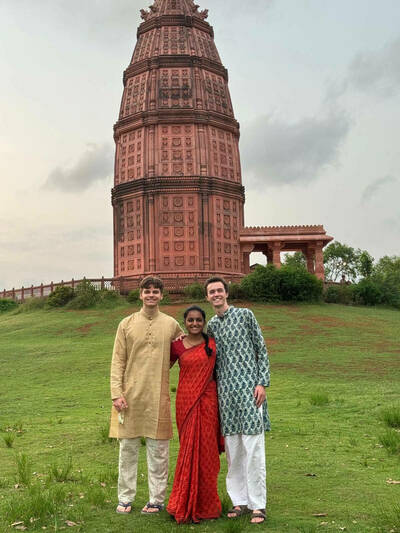
      <![CDATA[<figure class="image image-right"><img src="https://mumbai.nd.edu/assets/584650/400x/ty_india_article_2.jpg" alt="Ty Harrington stands in front of the Madana-mohana temple at Govardhan Ecovillage" width="600" height="800"></figure>
<p>Ty Harrington, a junior from Carmel, Indiana, majoring in liberal studies with a double major in philosophy and theology, spent his summer immersed in a unique and transformative experience in India. Ty’s journey led him to a wellness ashram known for its advanced research and implementation of sustainable practices, where he explored the philosophical connections between spirituality, sustainability, and the climate crisis.</p>
<h5>A Path to India: How It All Began</h5>
<p>The opportunity to spend the summer in India was a result of Ty’s participation in the <a href="https://socialconcerns.nd.edu/summer-fellowship-opportunities/">Center for Social Concerns Summer Fellowship</a>, a program designed for rising juniors and seniors interested in service, spirituality, and academic research. Ty's curiosity about the philosophical underpinnings of the climate crisis guided the Center's faculty to match him with <a href="https://ecovillage.org.in/">Govardhan Ecovillage (GEV)</a>. GEV, situated near Mumbai, serves as both a spiritual retreat and a hub for sustainability research, making it the ideal location for him to pursue his interests in philosophy, spirituality, and environmental issues.</p>
<p>“I was interested in understanding the philosophical foundations of the climate crisis—how different thinkers over time perceive our relationship with the natural world,” Ty explained. “GEV was the perfect place to explore this, as it integrates philosophy, spirituality, and sustainability in addressing the climate crisis.”</p>
<h5>The Research: Spirituality and Sustainability</h5>
<p>Ty’s research project, titled "Spirituality and Sustainability: Modern Cosmology, Spiritual Cosmology, and Vedanta Hinduism at Govardhan Ecovillage," delves into the relationship between spirituality and environmental stewardship. At the heart of his research is a profound question: “What does spirituality have to do with sustainability?”</p>
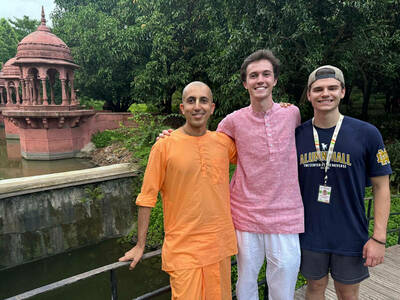
<figure class="image image-left"><img src="https://mumbai.nd.edu/assets/584649/400x/ty_india_article_1.jpg" alt="Ty Harrington with friends in India" width="600" height="450"></figure>
<p>To answer this, Ty explored two dimensions: the individual level and the philosophical level. At the individual level, Ty argued that spiritual and religious practices inherently promote a life of virtue, which aligns with environmentally friendly behaviors. “Religions across the world encourage their followers to reduce greed, selfishness, and anthropocentrism—traits that are at the core of the climate crisis,” Ty noted. “By guiding individuals toward virtue, spirituality naturally mitigates the human behaviors that are most harmful to the environment.”</p>
<p>On a deeper, philosophical level, Ty's research contrasts modern cosmology with spiritual cosmology. “Modern cosmology often views the natural world as a collection of dead objects, separate from the divine,” he explained. “Spiritual cosmology, like that found at GEV, integrates the natural world within a holistic framework that includes both human beings and the divine, recognizing the sacredness of all life.”</p>
<p>Through this dual exploration, he argued that spirituality presents a radically new way of perceiving the natural world—one that does not see it as mere objects but as sacred entities interconnected with the divine.</p>
<h5>Connecting with Notre Dame’s Mission</h5>
<p>Ty feels that his research aligns well with Notre Dame’s mission to be a force for good, especially in the area of environmental justice. “Notre Dame, as a Catholic institution, has a unique role to play in discussions about how spirituality can address the climate crisis,” he emphasized. “This issue disproportionately impacts marginalized communities, and the University has the potential to be a leading voice in advocating for environmental awareness and justice.”</p>
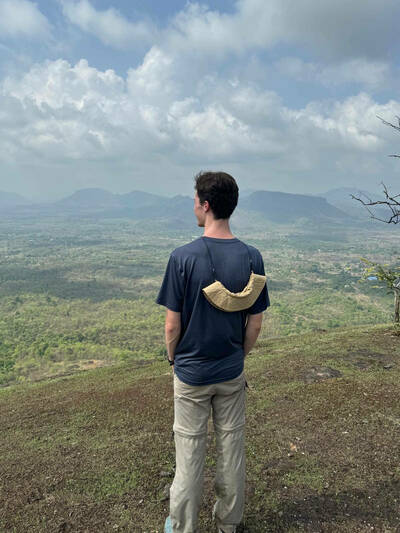
<figure class="image image-right"><img src="https://mumbai.nd.edu/assets/584659/400x/ty_india_article_4.jpg" alt="Ty Harrington looks out over a landscape" width="600" height="800"></figure>
<h5>Personal and Academic Takeaways</h5>
<p>Reflecting on his time at GEV, Ty shared that his biggest academic insight was discovering the shared truths between his Catholic faith and the spiritual tradition of Vedanta Hinduism. “It was intellectually satisfying to see authors from different traditions and times arrive at similar conclusions about the natural world,” he said. He found the ashram setting at GEV supportive of his faith, enjoying the serene, natural surroundings and cultural experiences like participating in the Rath Yatra festival.</p>
<p>His experience in India deepened his appreciation for the connections between different religious traditions, reinforcing his belief that spirituality can play a significant role in promoting environmental awareness.</p>
<h5>Looking Ahead</h5>
<p>Ty's time in India has profoundly shaped his worldview. “This experience has strengthened my faith while broadening my understanding of other traditions,” he shared. “I’m grateful for the opportunity to conduct this research in such a unique setting, and I hope it inspires others to see how spirituality can help address the world's most pressing issues.”</p>
<p>Ty’s journey to India highlights the transformative power of cross-cultural exchange and academic exploration, demonstrating that spirituality and sustainability are deeply linked—and both are essential in tackling the climate crisis together.</p>
<hr>
<p><em>Interested in pursuing a program in India? Visit the <a href="https://mumbai.nd.edu/">Notre Dame Mumbai</a> website to learn about study abroad and research opportunities.</em></p>
<p class="attribution">Originally published by <span class="rel-author">Hayden Mascarenhas</span> at <span class="rel-source"><a href="https://mumbai.nd.edu/news-stories/news/bridging-spirituality-and-sustainability-a-notre-dame-students-fellowship-in-india/">mumbai.nd.edu</a></span> on <span class="rel-pubdate">September 12, 2024</span>.</p>]]>
    </content>
    <link rel="enclosure" type="image/jpeg" href="https://pls.nd.edu/assets/584866/ty_india_article_3.jpg" title="Ty Harrington smiles with a group of friends in India."/>
    <author>
      <name>Hayden Mascarenhas</name>
    </author>
  </entry>
  <entry>
    <id>tag:pls.nd.edu,2005:News/161178</id>
    <published>2024-04-12T13:55:00-04:00</published>
    <updated>2024-06-12T09:41:10-04:00</updated>
    <link rel="alternate" type="text/html" href="https://pls.nd.edu/news-events/news/program-of-liberal-professor-reydams-schils-chosen-for-prestigious-guggenheim-fellowship/"/>
    <title>Program of Liberal Studies professor Gretchen Reydams-Schils chosen for prestigious Guggenheim Fellowship</title>
    <summary type="text">
      <![CDATA[Gretchen Reydams-Schils  Gretchen…]]>
    </summary>
    <content type="html">
      <![CDATA[<figure class="image image-right"><a href="https://pls.nd.edu/people/gretchen-reydams-schils/"><img src="https://pls.nd.edu/assets/566032/20240418_jlh_gretchen_reydams_schils_600x.jpg" alt="Gretchen Reydams-Schils" width="450" height="600"></a>
<figcaption>Gretchen Reydams-Schils</figcaption>
</figure>
<p><a href="https://pls.nd.edu/people/gretchen-reydams-schils/">Gretchen Reydams-Schils</a> has been awarded a 2024 <a href="https://www.gf.org/">Guggenheim Fellowship</a> in recognition of her career achievements and exceptional promise.</p>
<p>The professor in the <a href="https://pls.nd.edu/">Program of Liberal Studies</a><strong> </strong>is one of just 188 scholars, scientists, and artists chosen from approximately 3,000 applicants for the fellowship created in 1925 to add to the educational, literary, artistic, and scientific power of the country.</p>
<p>Guggenheim Foundation President Edward Hirsch said the fellows are meeting the profound existential challenges facing humanity head-on and are “generating new possibilities and pathways across the broader culture.”</p>
<p>In “‘Becoming like God:’ Perfection in Platonism and Stoicism (1c. BCE-2c. CE),” Reydams-Schils will seek to retrieve aspects of human perfection in antiquity that are empowering and relevant.</p>
<p>“The project yields a distinctive model of ‘self,’ the constitution of a human being, and virtue,” she said. “This model invites us to see ourselves as fundamentally embedded in the order of the universe and as being part of a densely woven fabric of social relations.”</p>
<p>In our current context, and in the sphere of human action, Reydams-Schils said, perfection can be seen as imposing a literally inhuman standard, which is unattainable, destructive, and an impediment to human happiness and flourishing.</p>
<p>Reydams-Schils, who has concurrent appointments in <a href="https://classics.nd.edu/">classics</a>, <a href="https://philosophy.nd.edu/">philosophy</a>, and <a href="https://theology.nd.edu/">theology</a>, said the fellowship is a validation of her vision for an interdisciplinary approach to ancient philosophy.</p>
<p>“My career narrative is also an ode to my department, the Program of Liberal Studies,” she said, “for the intellectual freedom it gave me to pursue this vision.”</p>]]>
    </content>
    <link rel="enclosure" type="image/jpeg" href="https://pls.nd.edu/assets/565998/gretchen_reydams_schils_headshot.jpg" title="Woman with short brown hair, wearing a tan blazer, white blouse, gold sweater, and patterned scarf, smiles at the camera from an office chair in front of bookshelves."/>
    <author>
      <name>Beth Staples</name>
    </author>
  </entry>
  <entry>
    <id>tag:pls.nd.edu,2005:News/161105</id>
    <published>2024-04-02T12:00:00-04:00</published>
    <updated>2024-04-12T13:51:18-04:00</updated>
    <link rel="alternate" type="text/html" href="https://pls.nd.edu/news-events/news/notre-dame-crucifix-initiative-announces-winners-of-inaugural-student-art-competition/"/>
    <title>Notre Dame Crucifix Initiative announces winners of inaugural student art competition</title>
    <summary type="text">
      <![CDATA[Through a campus-wide contest, the University of Notre Dame’s Crucifix Initiative has selected two original pieces by student artists to add to its permanent collection. The winning…]]>
    </summary>
    <content type="html">
      <![CDATA[<p>Through a campus-wide contest, the University of Notre Dame’s <a href="https://campuscrucifixes.nd.edu/">Crucifix Initiative</a> has selected two original pieces by student artists to add to its permanent collection. The <a href="https://campuscrucifixes.nd.edu/about/student-art-contest/2024-student-art-contest-winners/">winning artworks</a> by seniors K. Mae Harkins and Elijah Mustillo will be displayed in classrooms in O’Shaughnessy Hall, where they will inspire Notre Dame students for years to come.</p>
<p>Launched in 2019, the Crucifix Initiative seeks to reinforce the universalism of Catholicism and the internationalism of Notre Dame through an <a href="https://campuscrucifixes.nd.edu/campus-crucifixes/">expanding collection</a> of crucifixes from artists around the world, including unique pieces from Australia, Japan, Peru, Ukraine, Angola, Ireland, Germany, and more.</p>
<p>"From its beginning, the Notre Dame Crucifix Initiative has had three goals,” said founding director Mark Roche, Rev. Edmund P. Joyce, C.S.C. Professor of German Language and Literature. “First, to underscore the deep connections between Catholicism and the arts; second, to accentuate the internationalism and diversity of the Catholic Church, thereby enhancing the welcoming environment of Notre Dame, and third, to reinforce the links between Catholicism and student research, which in the arts involve creative work. We are delighted that as a result of this competition we have begun to fulfill this third goal."</p>
<p>Rev. Austin Collins, C.S.C., vice president for mission engagement and church affairs and a professor of studio art, said the selection committee was impressed with the artistry and diversity of the contest entries from undergraduate and graduate students across the University.</p>
<p>“All of the submissions were of high quality, and the artist statements were thoughtful and engaging,” Collins said. “I think we are off to a great start in this annual competition. I want to thank all who contributed and submitted artwork. I also want to thank the jurors for their careful consideration.”</p>
<p>Among many outstanding submissions, a ceramic piece by Harkins, a studio art and Spanish major, was selected as the inaugural winner for its creativity, skill, and attention to detail. “We appreciated the creative moments, including the African colors and the gesture to the Harlem Renaissance; the integration of a contemporary moment; and the subtle references to the Irish, with the green and orange and the nod to a shamrock,” the selection committee wrote.</p>
<p>Mustillo, a Program of Liberal Studies major, was selected as runner-up for his linocut block print accented with gold and the phrase “Jesus wept” in red lettering. The judges called the artwork “deeply thoughtful and very well crafted,” noting that they were particularly impressed by the work’s emphasis on grief and its portrayal of the dialectical nature of Christ.</p>
<p>Both students will receive a monetary prize and their crucifixes will be installed in classrooms in O’Shaughnessy Hall and added to the Crucifix Initiative’s website, <a href="http://campuscrucifixes.nd.edu">campuscrucifixes.nd.edu</a>.</p>
<p>The Initiative plans to hold a similar competition in the coming academic year. “I encourage any students who are interested to submit artwork next year," Collins said. Click <a href="https://docs.google.com/forms/d/e/1FAIpQLScDDsWeqORY1fW9_8fYqg93qn5A18XjXIfHAcx1W73MNwWa1A/viewform?usp=sf_link">here</a> to sign up for reminders about the 2025 contest.</p>
<p class="attribution">Originally published by <span class="rel-author">Kate Garry</span> at <span class="rel-source"><a href="https://campuscrucifixes.nd.edu/news/notre-dame-crucifix-initiative-announces-winners-of-inaugural-student-art-competition/">campuscrucifixes.nd.edu</a></span> on <span class="rel-pubdate">April 02, 2024</span>.</p>]]>
    </content>
    <link rel="enclosure" type="image/png" href="https://pls.nd.edu/assets/564852/2024_art_contest_winners.png" title=""/>
    <author>
      <name>Kate Garry</name>
    </author>
  </entry>
  <entry>
    <id>tag:pls.nd.edu,2005:News/159168</id>
    <published>2024-01-12T15:24:00-05:00</published>
    <updated>2024-01-12T15:24:21-05:00</updated>
    <link rel="alternate" type="text/html" href="https://pls.nd.edu/news-events/news/professor-katie-bugyis-wins-neh-fellowship/"/>
    <title>Professor Katie Bugyis Wins NEH Fellowship</title>
    <summary type="text">
      <![CDATA[Three faculty members in the College of Arts &amp; Letters have won National Endowment for the Humanities (NEH) fellowships, extending the University of Notre Dame’s record success with the federal agency committed to supporting original…]]>
    </summary>
    <content type="html">
      <![CDATA[<p>Three faculty members in the <a href="https://al.nd.edu/">College of Arts &amp; Letters</a> have won <a href="https://www.neh.gov/">National Endowment for the Humanities</a> (NEH) fellowships, extending the University of Notre Dame’s record success with the federal agency committed to supporting original research and scholarship.</p>
<p><a href="https://philosophy.nd.edu/people/faculty/shane-duarte/">Shane Duarte</a>, an associate professor of the practice in the <a href="https://philosophy.nd.edu/">Department of Philosophy</a>; <a href="https://ftt.nd.edu/people/faculty/mary-celeste-kearney/">Mary Celeste Kearney</a>, an associate professor of <a href="https://ftt.nd.edu/">film, television, and theatre</a>; and <a href="https://philosophy.nd.edu/people/faculty/stephen-ogden/">Stephen Ogden</a>, the Tracey Family Associate Professor of Philosophy, are among the 82 scholars to be awarded the competitive fellowships, which were announced Tuesday.</p>
<p>Since 2000, Notre Dame faculty have won more NEH fellowships than any other university in the country.</p>
<p>Additionally, a pair of A&amp;L scholars — <a href="https://pls.nd.edu/people/katie-bugyis/">Katie Bugyis</a>, the Rev. John A. O'Brien Associate Professor in the <a href="https://pls.nd.edu/">Program of Liberal Studies</a>, and <a href="https://sacredmusic.nd.edu/people/faculty/margot-e-fassler/">Margot Fassler</a>, the Keough-Hesburgh Professor of Music History and Liturgy Emerita — have won a significant, three-year NEH Humanities Initiatives at Colleges and Universities grant to develop a website and to teach medieval liturgy.</p>
<p>“I am delighted and proud that the NEH has again supported our faculty members’ relevant and interesting projects,” said Sarah Mustillo, the I.A. O’Shaughnessy Dean of the <a href="http://al.nd.edu/">College of Arts &amp; Letters</a>. “These four awards highlight the quality of diverse academic research conducted by our experts in multiple fields as well as the excellent support provided by the <a href="https://isla.nd.edu/">Institute for Scholarship in the Liberal Arts</a> throughout the application process.”</p>
<h3><strong>Reinvigorating an underserved field</strong></h3>
<p>With support from their NEH grant, Fassler and Bugyis will develop a website to preserve knowledge about the ritual practices of the medieval Roman Catholic Church and to provide instruction on how to locate, read, and interpret the relevant primary sources.</p>
<p>The pair are liturgical historians who “see our field as underserved,” Fassler said.</p>
<figure class="image image-right"><img src="https://al.nd.edu/assets/553390/fasslerbugyis.jpg" alt="Fasslerbugyis">
<figcaption>Margot Fassler and Katie Bugyis</figcaption>
</figure>
<p>“More scholars need to know about the medieval Latin liturgy than ever before,” she said, “and the goal of the website is to offer instruction in a field that has rarely been well-served by the academy.”</p>
<p>Resources and opportunities like digital libraries, catalogs, databases, and thousands of medieval manuscripts have now been made available online. Knowing how to utilize and navigate those resources, though, can be cumbersome and complicated.</p>
<p>“There’s all this material out there, but how do you use it?” Fassler asked. “Our whole enterprise is based on the solving of problems, and on utilizing the skills of our worldwide network of scholars to join in making tutorials.”</p>
<p>Bugyis and Fassler’s plan evolved into an ambitious project — “Medieval Liturgy: Tutorials for Students, Teachers, &amp; Researchers” and was initially supported with a <a href="https://research.nd.edu/our-services/funding-opportunities/faculty/internal-grants-programs/rsp-ig-past-recipients/">$100,000 seed grant</a> from Notre Dame Research — that is encyclopedic in its scope and pedagogical in its goals.</p>
<p>Their new website, hosted by the <a href="https://medieval.nd.edu/">Medieval Institute</a>, will feature peer-reviewed teaching videos that will systematically walk people through how to access and work with sought-after information. Fassler and Bugyis are inviting interdisciplinary liturgical scholars from Notre Dame and around the world to share their expertise, which will make their website a dynamic and evolving resource.</p>
<p>Main website sections will include resources on the fundamental components of medieval liturgy — the arrangement of the church year in its annual cycle; the performance of the hours of prayer that constituted the Divine Office in every monastic church and cathedral; and the celebration of Mass. Additional units will feature other liturgical rites, women’s rites, and liturgical music.</p>
<p>Understanding the liturgy is essential to understanding the Middle Ages, Bugyis said, but fewer and fewer graduate programs are training students in the liturgy.</p>
<p>“Notre Dame is one of the last places doing it. There is an abundance of resources here,” she said. “We saw a real opportunity, given the strengths that we have, to draw on the expertise of faculty and graduate students to create something new and important.”</p>]]>
    </content>
    <link rel="enclosure" type="image/jpeg" href="https://pls.nd.edu/assets/432391/katie_ann_marie_bugyis_headshot.jpg" title="A smiling woman with brown curly hair and glasses wears a dark blazer over a striped shirt."/>
    <author>
      <name>Eric Bugyis</name>
    </author>
  </entry>
  <entry>
    <id>tag:pls.nd.edu,2005:News/157568</id>
    <published>2023-10-27T15:03:00-04:00</published>
    <updated>2023-10-27T15:03:00-04:00</updated>
    <link rel="alternate" type="text/html" href="https://pls.nd.edu/news-events/news/professor-reydam-schils-featured-on-podcast/"/>
    <title>Professor Reydam-Schils Featured on Podcast</title>
    <summary type="text">
      <![CDATA[Gretchen Reydams-Schils (who also holds concurrent appointments in Classics, Philosophy, and Theology) was recently featured on an episode of The Secret History of Western Esotericism Podcast to discuss the late-antique philosopher Calcidius, whose partial Latin translation of and commentary…]]>
    </summary>
    <content type="html">
      <![CDATA[<p>Gretchen Reydams-Schils (who also holds concurrent appointments in Classics, Philosophy, and Theology) was recently featured on an episode of <em>The Secret History of Western Esotericism Podcast</em> to discuss the late-antique philosopher Calcidius, whose partial Latin translation of and commentary on Plato's <em>Timaeus</em> proved deeply influential across subsequent centuries. She recently published <a href="https://www.cambridge.org/us/universitypress/subjects/classical-studies/ancient-philosophy/calcidius-platos-timaeus-greek-philosophy-latin-reception-and-christian-contexts?format=HB&amp;isbn=9781108420563" target="_blank" data-saferedirecturl="https://www.google.com/url?q=https://www.cambridge.org/us/universitypress/subjects/classical-studies/ancient-philosophy/calcidius-platos-timaeus-greek-philosophy-latin-reception-and-christian-contexts?format%3DHB%26isbn%3D9781108420563&amp;source=gmail&amp;ust=1698519549323000&amp;usg=AOvVaw23sk6WLf-UsMR80kdC9fzm" rel="noopener"><em>Calcidius on Plato's Timaeus: Greek Philosophy, Latin Reception, and Christian</em> <em>Contexts</em></a>, the first book-length study on the entirety of Calcidius' commentary on the <em>Timaeus</em>. You can listen to the podcast <a href="https://shwep.net/podcast/gretchen-reydams-schils-on-calcidius-and-the-timaeus/?fbclid=IwAR03U_HE0e2YDpuY03D9ekE7tikA1SuUWKRcqTiKs8QCk1izdLHM7MzdKQ4">here</a>.</p>]]>
    </content>
    <link rel="enclosure" type="image/jpeg" href="https://pls.nd.edu/assets/545682/calcidius_diagram_brussels_5093_fol._26v_detail.jpeg" title="Calcidius Diagram"/>
    <author>
      <name>Program of Liberal Studies</name>
    </author>
  </entry>
  <entry>
    <id>tag:pls.nd.edu,2005:News/156091</id>
    <published>2023-09-11T13:55:00-04:00</published>
    <updated>2023-09-11T13:58:21-04:00</updated>
    <link rel="alternate" type="text/html" href="https://pls.nd.edu/news-events/news/judge-steven-bell-pls-75-re-experiences-the-simple-joy-of-learing/"/>
    <title>Judge Steven Bell, PLS '75, re-experiences "the simple joy of learning"</title>
    <summary type="text">
      <![CDATA[It had been 50 years since I sat in a PLS seminar room. It had been a half century since I last sat around a table with a group of eager students discussing a great book.I traveled back to campus in June to join the 2023 Program of Liberal Studies Summer Symposium. I was hooked when I learned…]]>
    </summary>
    <content type="html">
      <![CDATA[<p>It had been 50 years since I sat in a PLS seminar room. It had been a half century since I last sat around a table with a group of eager students discussing a great book.<br><br>I traveled back to campus in June to join the 2023 Program of Liberal Studies Summer Symposium. I was hooked when I learned the title of the Symposium: “Will the World be Saved by Beauty? Aesthetics and the Common Good.” <br><br>I graduated from the Program in 1975. After law school, I became an Assistant U.S. Attorney. I was then in private practice for many years before becoming a judge. I am fortunate to have many bright lawyers argue before me every day. I read hundreds of pages of legal briefs and documents every week. I write many opinions and orders each year. It is a gift to remain intellectually challenged.<br><br>I have forgotten much about the great books I read so many years ago in the Program. I would be hard-pressed to pass one of the oral exams we used to face at semester’s end. But the lessons learned in the PLS seminar rooms have stayed with me through all this time: I have not forgotten the wonder of learning. I have not forgotten the joy of being able to form and express a coherent opinion. I have never stopped admiring the faculty who have quietly influenced my thinking for all these years. It has never escaped me that I learned as much from my fellow students as from any of the books we studied together.<br><br>I walked into the first class of the Symposium on Monday morning and took a seat at the foot of the table. Professor Eric Bugyis began a 4-day exploration of Fyodor Dostoevsky’s <em>The Idiot</em>. A group of strangers collectively followed the personal and moral interactions of Prince Lev Nikolayevich Myschkin (“a believable Christ figure”), with a pageant of less beautiful souls in 19th century St. Petersburg. We talked. We cited text. We discussed what it might mean for someone to be “Christ-like.” We struggled with a hundred Russian names. We disagreed and explained our views. Strangers began to bond in conversation.<br><br>Professor Phil Sloan helped us explore beauty as found in the natural world. For several days, we traced theories of the movement of heavenly bodies from Ptolemy to Copernicus to Kepler to Newton. One highlight of Professor Sloan’s class was an evening visit to the Digital Visualization Theater in the (relatively) new Jordan Science Hall. In the DVT, Professor Sloan and an astronomer were able to show and discuss breathtaking high-resolution photos of deep space recently taken by the Webb Space Telescope. <br><br>Professor Sloan then turned from the beauty of planetary movement to how beauty might be expressed in the biological world. Readings from Galen, Aristotle, Goethe were considered before we turned our attention to Darwin and then to Watson and Crick’s discovery of the DNA double helix.<br><br>Afternoon sessions featured Professor Steve Fallon reading with us poems by Emily Dickinson. The Dickinson poems came to life during the class discussions. I wondered how many others had ever been so fortunate as to participate in three days of a brilliantly guided discussion of poetry. <br><br>Professor Chris Chowrimootoo led a fascinating week-long discussion centered around Thomas Mann’s 1912 novella <em>Death in Venice</em>. Philosophical prehistories, including Plato’s <em>Phaedrus</em> and Nietzsche’s <em>Birth of Tragedy</em> were considered before an exploration of Mann’s novella was initiated. On the fourth day of Professor Chowrimootoo’s class, Luchino Visconti’s 1971 film of <em>Death in Venice</em> was viewed and discussed. On the final day of the class, we watched and discussed Benjamin Britten’s remarkable opera <em>Death in Venice</em>. The opportunity to study the original work in some depth, and to then consider the alternative presentations of the story in Visconti’s film and Britten’s opera allowed the participants to explore the ambiguities and challenges presented by Mann’s novella. <br><br>A somewhat “formal” dinner was held in the South Dining Hall on the penultimate evening of the Symposium. The dinner allowed us to reflect on the discussions of the week, and to cement new bonds of friendship. <br><br>I was intimidated when I first saw the readings selected for the Symposium. I thought I might have forgotten how to read something other than legal paperwork. I thought I might have forgotten the pleasure of understanding a poem. With the help of the incredible PLS faculty and my fellow students, I came away from the Symposium reminded of the lifelong gift of curiosity and reminded of the simple joy of learning. <br><br>Steve Bell<br>General Program of Liberal Studies, Class of 1975</p>]]>
    </content>
    <link rel="enclosure" type="image/jpeg" href="https://pls.nd.edu/assets/536973/img_5152.jpg" title="Img 5152"/>
    <author>
      <name>Program of Liberal Studies</name>
    </author>
  </entry>
  <entry>
    <id>tag:pls.nd.edu,2005:News/151827</id>
    <published>2023-03-20T15:15:00-04:00</published>
    <updated>2023-03-22T16:11:50-04:00</updated>
    <link rel="alternate" type="text/html" href="https://pls.nd.edu/news-events/news/pls-faculty-collaborate-on-new-early-christian-philosophy-series/"/>
    <title>PLS Faculty Collaborate on New Early Christian Philosophy Series</title>
    <summary type="text">
      <![CDATA[…]]>
    </summary>
    <content type="html">
      <![CDATA[<figure class="image-right">
<figure class="image-right"><img alt="Gretchen Reydams Schils" height="200" src="https://pls.nd.edu/assets/433040/200x200/gretchen_reydams_schils1.jpg" width="200"></figure>
<figure class="image-right"><img alt="Andrew Radde Gallwitz" height="200" src="https://pls.nd.edu/assets/433025/200x200/andrew_radde_gallwitz.jpg" width="200"></figure>
<p> </p></figure>
<p>Andrew Radde-Gallwitz (Program of Liberal Liberal Studies, Classics, and Theology) and Gretchen Reydams-Schils (Program of Liberal Studies, Classics, Philosophy, and Theology) have set up a new collaboration with Johannes Zachhuber  (Oxford University) and Anna Marmordoro (Oxford University/Durham) for <strong>Early Christian Philosophy</strong>.   The initiative consists of yearly colloquia (alternating between Notre Dame and other venues) on a Christian text, as well as a new book series to be published by Oxford University Press, called <em>Library of Early Christian Philosophy</em>.</p>
<p><br>
Each interdisciplinary volume will provide an introduction, the original text, a translation, and a number of essays illuminating the philosophical aspects of these accounts in their theological contexts.  The first volume, dedicated to Gregory of Nyssa's <em>On the Six Days of Creation</em>, is scheduled to appear in 2024.</p>]]>
    </content>
    <link rel="enclosure" type="image/jpeg" href="https://pls.nd.edu/assets/509583/headshot_collage_1.jpg" title="Headshot Collage 1"/>
    <author>
      <name>Marie Revak</name>
    </author>
  </entry>
  <entry>
    <id>tag:pls.nd.edu,2005:News/151256</id>
    <published>2023-02-24T10:42:00-05:00</published>
    <updated>2025-09-17T16:28:21-04:00</updated>
    <link rel="alternate" type="text/html" href="https://pls.nd.edu/news-events/news/pls-taught-maria-antoniak-11-to-ask-the-right-questions-and-led-to-data-and-computer-science-career/"/>
    <title>How the Program of Liberal Studies taught Maria Antoniak ’11 to ask the right questions — and led to a career in data and computer science</title>
    <summary type="text">
      <![CDATA[For Maria Antoniak ’11, a liberal arts education isn’t about having all the answers — it’s about learning what questions to ask. After four years studying great books in the Program of Liberal Studies, she’s now spent nearly a decade working in data and computer science across industry, nonprofit, and academic settings. “The background of PLS helps me engage critically with a dataset,” Antoniak said. “Asking creative and critical and pertinent research questions that try to get at the heart of things as quickly as possible — that comes partly from PLS and diving deeply into a text.”]]>
    </summary>
    <content type="html">
      <![CDATA[<p>For Maria Antoniak ’11, a liberal arts education isn’t about having all the answers — it’s about learning what questions to ask.</p>
<p>After four years studying great books in the <a href="https://pls.nd.edu/">Program of Liberal Studies</a>, she’s now spent nearly a decade working in data and computer science across industry, nonprofit, and academic settings.</p>
<p>In each, she’s relied upon foundational thinking skills she developed in <a href="http://al.nd.edu/">College of Arts &amp; Letters</a> courses.</p>
<p>“The background of PLS helps me engage critically with a dataset,” Antoniak said. “Asking creative and critical and pertinent research questions that try to get at the heart of things as quickly as possible — that comes partly from PLS and diving deeply into a text.”</p>
<h3>Carving out time</h3>
<p>Though Antoniak entered Notre Dame as a physics major, she was drawn to the liberal arts and the promise of engaging with classic works.</p>
<p>At a fair for students looking to explore the variety of majors offered at Notre Dame, Antoniak was intrigued by the diverse group of people in PLS — an interdisciplinary major consisting of small, discussion-based seminars centered around writing by many of the most influential thinkers in the Western tradition.</p>
<figure class="image-right"><img src="https://al.nd.edu/assets/504252/400x/maria_antoniak_pls_class.jpg" alt="Maria Antoniak Pls Class" width="400" height="269">
<figcaption>Antoniak (lower left) with her PLS classmates, pretending to be philosophers.</figcaption>
</figure>
<p>“One of the most valuable things about PLS is this beautiful luxury to spend precious time engaging with some of the greatest things that human beings have produced,” Antoniak said. “That, to me, is PLS — it's this carving out of time to engage with the books.”</p>
<p>Antoniak learned to carve out this space for introspection throughout her college experience.</p>
<p>During eight weeks of volunteer work at the Lopez Island Family Resource Center in Washington through the Center for Social Concerns’ <a href="https://socialconcerns.nd.edu/sslp">Summer Service Learning Program</a>, she also studied and wrote nature poetry in a directed readings course with Professor Emeritus <a href="https://pls.nd.edu/people/henry-weinfield/">Henry Weinfield</a>. And she taught poetry and writing for two summers in Assisi, Italy, and also spent three years as a tutor in the <a href="https://writing.nd.edu/writing-center/">Writing Center</a> on campus, helping other students refine their thinking across disciplines and course levels.</p>
<p>“It was great training for teaching and for understanding the value of writing,” she said.</p>
<p>When deciding on her next step after graduation, Antoniak aimed to combine interests that had flourished at Notre Dame — her passion for teaching and mentoring; her love for traveling abroad; and her interest in linguistics, which she strengthened by studying Italian, French, and Russian.</p>
<p>So she took a position teaching English at the Ukrainian Catholic University, a place unlike anywhere she had traveled before, and one that allowed her to connect with her Ukrainian heritage.</p>
<p>“I could see how that was really good for me as a human being — to meet different people, see different ways of living,” she said. “And I wanted more of that.”</p>
<blockquote>
<p>“One of the most valuable things about PLS is this beautiful luxury to spend precious time engaging with some of the greatest things that human beings have produced. That, to me, is PLS — it's this carving out of time to engage with the books.”</p>
</blockquote>
<h3>When passions ‘click’</h3>
<p>After a year of teaching, Antoniak was ready to return to being a student and forge a new career path.</p>
<p>She had happened to read about the field of computational linguistics and natural language processing, or the study of language from a computer science perspective.</p>
<p>“Knowing that there is this field of computer science that is combined with linguistics and human language, which I also love, that just seemed to click for me,” she said.</p>
<figure class="image-right"><img src="https://al.nd.edu/assets/504251/400x/maria_antoniak_cornell.jpg" alt="Maria Antoniak Cornell" width="400" height="488">
<figcaption>Antoniak earned her Ph.D. in information science at Cornell University.</figcaption>
</figure>
<p>So she enrolled in a master’s in computational linguistics at the University of Washington in her home state, where she took courses across linguistics, programming, machine learning, and more. After earning her degree, she worked as a data scientist at a startup in Seattle, but returned to academia in order to continue her research in natural language processing.</p>
<p>As a Ph.D. student in information science at Cornell University, Antoniak’s research used machine learning to analyze how people write about themselves, their interests, and their personal experiences online — ranging from reviews posted on the book-centric social networking site Goodreads to personal birthing narratives shared in healthcare support communities.</p>
<p>“In my research, I've thought about why people are sharing these stories in these particular settings,” she said. “Computationally, can we model these narratives in an unsupervised way in order to pick out both general patterns in these stories and outliers, and also to measure who is framed as having power and lacking power?”</p>
<p>Now, asking the right questions helps direct how Antoniak works with datasets using artificial intelligence tools.</p>
<p>“Where my research in natural language processing relies on some of that education is in thinking critically,” Antoniak said, “whether that is approaching ethical problems in natural language processing and machine learning, because these tools are now used in government settings and in applications that we all use every day, or also in approaching research problems.”</p>
<h3>‘Engaging with being human’</h3>
<p>Antoniak explored working in industry through internships at Pacific Northwest National Laboratory, Microsoft, Facebook, and Twitter, but eventually decided that she wanted to work in a different type of research environment.</p>
<figure class="image-left"><img src="https://al.nd.edu/assets/504253/350x/maria_antoniak_gates_hall.jpg" alt="Maria Antoniak Gates Hall" width="350" height="234">
<figcaption>Antoniak outside Cornell's Gates Hall for Computing and Information Science.</figcaption>
</figure>
<p>After graduating from Cornell, Antoniak joined a postdoctoral program at the Allen Institute for AI, a research center dedicated to exploring how AI and engineering can provide good to society and humanity. The nonprofit, founded by the late Microsoft co-founder Paul Allen, strives to do good in the world — a mission that resonated with Antoniak after her time at Notre Dame.</p>
<p>To Antoniak, the value of a liberal arts education is in becoming a better, deeply engaged person who is prepared to tackle the pressing ethical dilemmas of our time. And she’s found that it prepared her and her classmates to ask critical questions across a variety of career paths and disciplines upon their graduation.</p>
<p>“My class graduated during the recession, but we went on to be lawyers, journalists, scientists, writers, parents, teachers, businesspeople,” Antoniak said. “We had the confidence and grounding given to us by our hours of reading and debating and engaging with being human.”</p>
<blockquote>
<p>“My class graduated during the recession, but we went on to be lawyers, journalists, scientists, writers, parents, teachers, businesspeople. We had the confidence and grounding given to us by our hours of reading and debating and engaging with being human.”</p>
</blockquote>
<p class="attribution">Originally published by <span class="rel-author">Hailey Oppenlander</span> at <span class="rel-source"><a href="https://al.nd.edu/news/latest-news/pls-taught-maria-antoniak-11-to-ask-the-right-questions-and-led-to-data-and-computer-science-career/">al.nd.edu</a></span> on <span class="rel-pubdate">February 21, 2023</span>.</p>]]>
    </content>
    <link rel="enclosure" type="image/jpeg" href="https://pls.nd.edu/assets/505380/maria_antoniak_feature.jpg" title="Maria Antoniak Feature"/>
    <author>
      <name>Hailey Oppenlander</name>
    </author>
  </entry>
  <entry>
    <id>tag:pls.nd.edu,2005:News/149957</id>
    <published>2022-12-19T16:07:00-05:00</published>
    <updated>2023-03-02T11:10:17-05:00</updated>
    <link rel="alternate" type="text/html" href="https://pls.nd.edu/news-events/news/pls-welcomes-professor-arman-schwartz/"/>
    <title>PLS Welcomes Professor Arman Schwartz</title>
    <summary type="text">
      <![CDATA[This fall, the Program of Liberal Studies was proud to welcome two new musicologists to its faculty. Arman Schwartz is a new Assistant Professor, and Heather Wiebe is a Teaching Professor, whose time will be split between PLS and the Department of Music. Both of them come with extensive experience…]]>
    </summary>
    <content type="html">
      <![CDATA[<p>This fall, the Program of Liberal Studies was proud to welcome two new musicologists to its faculty. Arman Schwartz is a new Assistant Professor, and Heather Wiebe is a Teaching Professor, whose time will be split between PLS and the Department of Music. Both of them come with extensive experience teaching at universities primarily in the United Kingdom, a distinguished list of scholarly publications, and superlative international reputations.</p>
<p>In the midst of a hectic fall semester, we caught up with Professor Schwartz, who was teaching our junior "Music and Meaning" tutorial. This spring he will be offering a section of our senior "great books" Seminar VI, which covers an interdisciplinary selection of key texts from the late 19th and the first half of the 20th century. What follows is a lightly edited transcript of our conversation.</p>
<p><strong>How did you first get interested in Musicology?</strong><br>
 <br>
My story is pretty common among musicologists. I started out as a pianist and composer. Then midway through college—thanks, in no small part, to the University of Chicago’s Common Core curriculum—I got increasingly interested in history, literature, and philosophy. Ultimately, and after a lot of soul searching, I decided that I enjoyed the challenge of writing about music more than that of simply writing it. Or, to put this differently, musicology offered me a way to explore the questions that, previously, I’d only known how to explore through more practical forms of musical engagement.<br>
 <br>
<strong>Where were you before coming to Notre Dame, and what attracted you to Notre Dame and the Program of Liberal Studies?</strong><br>
 <br>
I was based in England for the last nine years—teaching at King’s College London and, before that, the University of Birmingham. One thing that attracted me to PLS was the opportunity to teach music to non-music majors—something that isn’t possible in the UK educational system, but that has always been tremendously important to me personally. Beyond that, I was thrilled by the opportunity to work in a program founded on many of the same ideas [coming out of <a href="https://pls.nd.edu/about/">the "Great Books" movement</a>] that changed my own life as an undergraduate. And it seemed like a way to force myself to finally finish <em>War and Peace</em>!<br>
 <br>
<strong>What is you current research? How does it relate to your past research, and what new avenues are you opening up both in your own work and in the field?</strong><br>
 <br>
I’m currently working on a book called <em>Music and Idealism in Italy, 1880-1950</em>. In the past ten years or so, musicologists have gotten very interested in material culture—in instruments, technologies, performers’ bodies, and other types of “things.” I’m curious about what would happen if we tried to take seriously much older, and seemingly sillier, ideas about music as some sort of transcendent force, and I think we need to take those ideas seriously to understand the peculiar way that modernism developed in fin-de-siècle Italy. Much of my previous research has been concerned with the paradoxical notion of operatic “realism,” especially as it intersects with the broader history of sound and sound recording. This new project has been a way to think not just about realism, but about its limitations and frustrations.<br>
 <br>
<strong>What would you say to someone who has always wanted to study music or learn an instrument but feels that they don't have the time and might be a little intimidated? </strong><br>
 <br>
Just do it! One thing I’ve come to appreciate in the past few years is the joy not just of learning new hobbies, but of being bad at new hobbies. Maybe especially ones that make your mind and body work in different and potentially disconcerting ways.<br>
 <br>
<strong>How and/or what can the study of music contribute to living a good life?</strong><br>
 <br>
That’s tricky. It might be easier to start by saying what I don’t believe. I’ve never had much sympathy for arguments that studying harmony can make you more harmonious, or that learning to listen to music can make you better at listening to the world around you. It may be worth recalling that if the myth of Orpheus begins with a classic image of the good life—a happy wedding, attended by gods—it ends with the the greatest musician in antiquity being dismembered by a mob of angry women. The French philosopher Vladimir Jankélévitch once wrote that: “To grant music a moral function […] it would seem necessary to amputate and discard all its pathos, everything heady and orgiastic in it, and, finally, to deprive oneself of poetic intoxication in any form.” He may have been thinking of the fate of Orpheus when he used that strange word “amputate.” In any case, if Jankélévitch's sentence doesn’t make you want to learn more about music, I don’t know what will.</p>]]>
    </content>
    <link rel="enclosure" type="image/jpeg" href="https://pls.nd.edu/assets/485394/bj_8.25.22_arman_schwartz.jpg" title="Bj 8"/>
    <author>
      <name>Program of Liberal Studies</name>
    </author>
  </entry>
  <entry>
    <id>tag:pls.nd.edu,2005:News/148880</id>
    <published>2022-10-28T13:10:00-04:00</published>
    <updated>2022-10-28T15:02:20-04:00</updated>
    <link rel="alternate" type="text/html" href="https://pls.nd.edu/news-events/news/in-memoriam-mary-katherine-tillman-professor-emerita-program-of-liberal-studies/"/>
    <title>In memoriam: Mary Katherine Tillman, professor emerita, Program of Liberal Studies</title>
    <summary type="text">
      <![CDATA[Mary Katherine Tillman, a professor emerita in the Program of Liberal Studies, died at Wellbrooke Senior Care Residence on Oct. 21, of complications associated with esophageal cancer. She was 81. Tillman was a scholar of St. John Henry Cardinal Newman, writing a book and several extended commentaries on the works of the19th-century English priest, as well as the history and philosophy of liberal education. ]]>
    </summary>
    <content type="html">
      <![CDATA[<figure class="image-right"><img alt="Mary Katherine Tillman" height="488" src="https://al.nd.edu/assets/491960/400x/mary_katherine_tillman.jpg" width="400">
<figcaption>Mary Katherine Tillman</figcaption>
</figure>

<p><a href="https://pls.nd.edu/people/mary-katherine-tillman/">Mary Katherine Tillman</a>, a professor emerita in the Program of Liberal Studies, died at Wellbrooke Senior Care Residence on Oct. 21, of complications associated with esophageal cancer. She was 81.</p>

<p>She was a member of the Notre Dame faculty for 33 years, retiring in 2006, a tenure that included serving as assistant provost from 1979 to 1982. </p>

<p>Tillman was a scholar of St. John Henry Cardinal Newman, writing a book and several extended commentaries on the works of the19th-century English priest, as well as the history and philosophy of liberal education. </p>

<p>She published widely in scholarly journals and gave lectures throughout the U.S. and Europe, and in 2019 received the Gailliot Award for Lifetime Achievement in Newman Studies from the National Institute for Newman Studies.</p>

<p>"Katherine's love of St. John Henry Newman was infectious,” said <a href="https://pls.nd.edu/people/thomas-a-stapleford/">Thomas Stapleford</a>, an associate professor and former chair of PLS. “She did more than anyone else to deepen my appreciation and understanding of Newman's work, generously sharing books, answering questions, and teaching me about the scholar and Christian whom she so admired."</p>

<p>Tillman was born in St. Louis to two Saint Louis University professors, then earned degrees from Mundelein College, Saint Louis University, and the New School for Social Research in New York City. She taught at Rutgers University, Mundelein College, and Clarke College before coming to Notre Dame. </p>

<p>She taught PLS’s Great Books Seminars, as well as courses on Newman, philosophy, ethics, and metaphysics. In 1985, she won the <a href="https://al.nd.edu/about/the-faculty/college-awards/sheedy-teaching-award/">Sheedy Award for Excellence in Teaching</a>, the highest teaching honor in the College of Arts &amp; Letters. </p>

<p>She was known as a mentor to students but also to new PLS faculty, offering advice and encouragement on how to inspire confidence in students to take on great works by great minds.</p>

<p>“Katherine Tillman was a legendary teacher, a wonderful colleague and mentor to younger faculty, and an important scholar of the life and works of John Henry Newman,” said <a href="https://pls.nd.edu/people/stephen-m-fallon/">Stephen Fallon</a>, the John J. Cavanaugh Professor of the Humanities in PLS and English. “I’ve always been grateful for her generosity in co-teaching a Great Books seminar with me when I arrived in 1985, which allowed me to learn from a master and to get to know Katherine as a friend.”</p>

<p>She is survived by her husband, <a href="https://reilly.nd.edu/people/faculty/phillip-sloan/">Phillip R. Sloan</a>, a professor emeritus in PLS and the History and Philosophy of Science program; siblings Claire Tillman Koch of St. Charles, Missouri; William L. Tillman (Susan) of Richards, Missouri; Thomas (Deborah) Tillman of Wentzville, Missouri; and by nieces, nephews, and step-children. </p>

<p>A reception and remembrance service was held Thursday, Oct. 27, and a Mass of Christian Burial was held in the Basilica of the Sacred Heart at Notre Dame on Friday, Oct. 28, followed by burial in Cedar Grove Cemetery at Notre Dame. Contributions in her name can be made to Catholic Relief Services.</p>

<p class="attribution">Originally published by <span class="rel-author">Josh Weinhold</span> at <span class="rel-source"><a href="https://al.nd.edu/news/latest-news/in-memoriam-mary-katherine-tillman-professor-emerita-program-of-liberal-studies/">al.nd.edu</a></span> on <span class="rel-pubdate">October 28, 2022</span>.</p>]]>
    </content>
    <link rel="enclosure" type="image/jpeg" href="https://pls.nd.edu/assets/491963/mary_katherine_tillman_thumbnail.jpg" title="Mary Katherine Tillman Thumbnail"/>
    <author>
      <name>Josh Weinhold</name>
    </author>
  </entry>
  <entry>
    <id>tag:pls.nd.edu,2005:News/148011</id>
    <published>2022-09-22T13:18:00-04:00</published>
    <updated>2022-09-22T14:22:56-04:00</updated>
    <link rel="alternate" type="text/html" href="https://pls.nd.edu/news-events/news/trans-atlantic-and-interdisciplinary-scholarship-jennifer-newsome-martin/"/>
    <title>Trans-Atlantic and Interdisciplinary Scholarship: Jennifer Newsome Martin</title>
    <summary type="text">
      <![CDATA[Jennifer Newsome Martin, Associate Professor in the Program of Liberal Studies with a joint appointment in the Department of Theology, has had a year that highlights the role of international and interdisciplinary collaboration in her work and thought.  …]]>
    </summary>
    <content type="html">
      <![CDATA[<p><span style="background:white"></span>Jennifer Newsome Martin, Associate Professor in the Program of Liberal Studies with a joint appointment in the Department of Theology, has had a year that highlights the role of international and interdisciplinary collaboration in her work and thought.</p>
<p> </p>
<p>Alongside colleagues from KU Leuven in Belgium and Villanova University, Professor Martin has launched a new monograph series with Bloomsbury/T&amp;T Clark, “T&amp;T Clark Explorations at the Crossroads of Theology &amp; Aesthetics.” The first book in the series, on Fyodor Dostoevsky, is slated to appear by the end of the year. </p>
<p>Other new national and international interdisciplinary collaborations include Professor Martin’s recent partnership—with faculty from Georgetown and other American universities—with La Civiltà Cattolica and the Council of Culture and Education in Rome to organize the international conference “The Catholic Imagination on the Global Stage,” as well as invited membership in both the Northwestern University Research Initiative for the Study of Russian Philosophy and Religious Thought and the International Network in Philosophy of Religion based in Paris, France. This summer, Professor Martin spent time in Dublin, Ireland, presenting new work on the poetry of Gerard Manley Hopkins and visiting sites important for understanding his life and works.</p>
<p>Professor Martin’s work continues to reach a broadening audience: for instance, her 2021 article, “The Annunciation of the Flesh: Bodily Mediation in the Work of Charles Péguy”—a theological meditation on the theme of corporeality in the poetry and prose of the French poet—was printed in the Polish edition of Communio as “Zwiastowanie ciała: mediacja cielesna w twórczości Charlesa Péguy,” Communio: Międzynarodowy Przegląd Teologiczny Nr 3 (215) Rok XLI (2021).</p>
<p>“It’s a genuine gift to be able to join forces with such talented scholars, educators, and Church leaders from across the globe,” she said. “In a time when we might feel distant from one another, I’m especially edified to witness and cooperate with the good work of my colleagues at other institutions.”</p>
<figure> </figure>
<p> </p>]]>
    </content>
    <link rel="enclosure" type="image/jpeg" href="https://pls.nd.edu/assets/432390/jennifer_newsome_martin_2_2_.jpg" title="Jennifer Newsome Martin"/>
    <author>
      <name>Marie Revak</name>
    </author>
  </entry>
</feed>